
Edo Kiriko Handcrafted Kinryu Whisky Glass
In the mythology of East Asia, the dragon does not hoard gold or terrorize villages. It commands water, weather, and wisdom. It dwells in the depths of oceans and rises through storms to the heavens. It is a creature of both terror and benevolence—a symbol of power wielded wisely, prosperity shared generously, and protection offered without expectation. To hold a dragon is to hold a legend. To drink from one is to invoke its virtues.
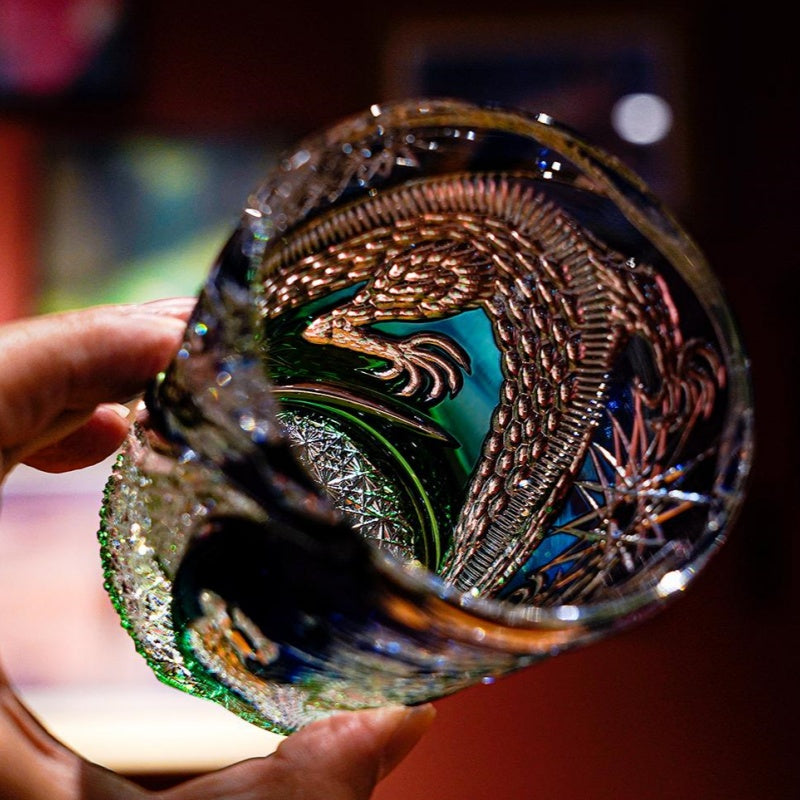
The Edo Kiriko Handcrafted Kinryu Whisky Glass captures this legendary creature not in paint or ink but in deep blue and emerald crystal—carved, polished, and illuminated from within. The Kinryu (Golden Dragon) does not rest on the surface of the glass. It lives inside it, curled through layers of color, its scales catching light like the flanks of a fish in deep water. This is not merely a drinking vessel. It is a statement of power, a guardian of spirits, and a masterpiece of Japanese cut-glass artistry.

The Dragon Reimagined: Power in Crystal
The dragon motif in Japanese art is ancient and codified. It appears on temple ceilings, sword fittings, festival floats, and ceremonial robes. Each element carries meaning: the whiskers signify wisdom, the claws signify authority (three claws for earthly dragons, four for celestial), the serpentine body signifies adaptability, and the pearl often clutched or pursued signifies spiritual treasure.
The Kinryu Whisky Glass honors this iconography with remarkable fidelity. The dragon is carved in full relief—not as a flat engraving but as a dimensional sculpture that emerges from the crystal wall. Its scales are rendered as overlapping diamond cuts, each one polished to catch light from a different angle. Its claws are sharp, defined, and positioned as if gripping the curve of the glass. Its whiskers flow backward, suggesting motion through water or wind. Its body coils through the composition, wrapping around the bowl of the glass in a continuous, fluid line.
Carving a dragon motif in the *Edo Kiriko* tradition presents a unique artistic challenge. While traditional *Kiriko* patterns typically consist of geometric forms—such as diamonds, grids, stars, and stripes—the dragon motif demands the use of dynamic curves, fluid lines, and asymmetrical composition. The artisan must achieve a seamless transition between the rigorous geometric structure of the background patterns and the fluid, unconstrained rhythm of the dragon's form. A single misstep—even if it involves nothing more than a single angle failing to align with absolute precision—will cause the dragon to lose its overall coherence, disintegrating entirely into a chaotic jumble of disconnected facets.
"Kinryu" executes this transition flawlessly. The image of the dragon appears not as an intrusion amidst the surrounding geometric facets, but rather as if emerging from a chrysalis—as though these very patterns had given birth to the creature itself. The effect is at once breathtaking and entirely natural—the dragon seems to have lain dormant within the crystal all along, finally revealing its true form through the sculptor's patient, subtractive carving.

The Colors of Depth: Deep Blue and Emerald Green
Where previous pieces in this collection—the Sakura, the Kingyo, the Rose Koi—have celebrated reds and greens in varying combinations, the Kinryu Whisky Glass introduces a new and dramatic palette: deep blue transitioning into emerald green. These are the colors of the sea, of deep water, of the dragon's natural element.

The blue is not bright or primary. It is kon—a deep, slightly indigo blue that evokes the ocean at twilight, the sky before a storm, the ink of a master calligrapher. The green is midori—fresh but not pale, rich but not garish, the color of ancient bronze and deep forest pools. Together, they create a gradient that shifts as the glass is turned. In one light, the blue dominates, and the dragon swims in midnight waters. In another, the green rises to the foreground, and the creature seems to surface into a sunlit sea.
This color transition is achieved through the same extraordinarily difficult three-layer fusion process used in the Supreme Collection. The glass blank begins as separate layers of molten crystal—blue, clear, and green—fused at temperatures that allow bonding without mixing. The artisan then cuts through these layers to different depths. Shallow cuts reveal the blue layer. Deeper cuts penetrate to the green. The dragon's body, carved at varying depths, incorporates both colors simultaneously. Its back may be blue, its belly green, its scales flashing between the two with every shift of the light.
No other cut-glass tradition achieves this effect. European crystal relies on surface cutting and clear glass, with color added externally or through single-layer tinting. Edo Kiriko alone has mastered the art of layered, multicolored crystal carving. The Kinryu represents this mastery at its most ambitious.
The Dragon Emerges: Dimensional Carving
The carving of the "Golden Dragon" is a process spanning several weeks, demanding not only exquisite craftsmanship but also a unique artistic vision. The artisan begins with a rough blank—specifically, a cylindrical section of cast blue-green crystal. Subsequently, the master, wielding a soft graphite pencil, freehand sketches the image of the dragon directly onto the crystal's curved surface. Throughout this stage, no templates are utilized, nor are any transfer techniques employed. This drafting process necessitates a thorough consideration of the crystal's three-dimensional form, involving the judicious compression and elongation of the dragon's body to ensure it fits perfectly within the vessel's overall contours.
The rough cutting follows. Coarse diamond wheels establish the major volumes—the head, the body coils, the tail. At this stage, the dragon looks blocky and unfinished, like a sculpture emerging from rough stone. The artisan works by feel, testing depths with fingertips, checking angles against the light.
Then comes the detail carving—the work that separates a competent dragon from a breathtaking one. Fine diamond wheels trace the scales, each one a tiny geometric cut that must align with its neighbors in a continuous overlapping pattern. The claws require cuts so fine that the wheel must be changed every few minutes to maintain sharpness. The whiskers—curving, tapering lines that extend from the snout—must be carved freehand in a single continuous motion. Any hesitation, any correction, and the line will show a wobble.
The eyes are the most demanding feature. A dragon's eye, in traditional iconography, is not merely round but slightly almond-shaped, with a sharp outer point and a defined pupil. The artisan carves this with a series of micro-cuts—sometimes five or six separate facets—that catch light from multiple directions. When finished, the eye appears to follow the viewer, glowing with an inner fire.
Finally, the polishing begins. Each cut surface must be polished to transparency—not left frosted, as in some cut-glass traditions. The artisan uses felt wheels charged with rare-earth oxides, working progressively finer until the dragon's scales shine like wet lacquer. The polishing alone can take as long as the carving.
Geometry as Counterpoint: Stars and Lattice
Surrounding the dragon, the glass is carved with traditional Edo Kiriko geometric patterns that serve both as ornament and as structural contrast. The starburst elements—four-point and eight-point stars—create concentrated points of brilliance that anchor the composition. Placed strategically around the dragon, they act like celestial guides, drawing the eye through the creature's curves.
The precise lattice patterns—grids of tiny intersecting diamonds—fill the remaining space. Unlike the dragon's flowing lines, the lattice is rigid, mathematical, and repetitive. This contrast is essential. The dragon appears more fluid, more alive, because it is surrounded by geometry. The lattice does not compete with the creature; it frames it, highlights it, releases it.
This balance between organic and geometric, between freedom and control, is the secret of Edo Kiriko's aesthetic power. The Kinryu Whisky Glass achieves it perfectly. Turn the glass slowly, and the relationship shifts. Sometimes the dragon dominates, and the patterns recede into background texture. Sometimes the stars flash brightly, and the dragon becomes a dark shape against a field of light. The composition is never static, never predictable.
The Radiant Base: Light from Below
Many cut-glass vessels neglect the base. The Kinryu does not. The underside of the glass is finished with intricate hand-cut patterns specifically designed to refract light upward through the body. When the glass is set on a table, light enters from below—passing through the base patterns, scattering into the blue and green layers, and illuminating the dragon from beneath.
This radiant glow is a signature of the highest-grade Edo Kiriko. The base is not simply flat or roughly polished. It is carved with a sunburst or spiral pattern that acts like a lens, gathering ambient light and directing it into the crystal. The effect is subtle in dim light and dramatic in direct sun. The dragon appears to glow from within, its scales shimmering, its body alive with captured light.
For the drinker, this means that the glass is beautiful even when empty. For the collector, it means that display—on a shelf, in a cabinet, near a window—reveals new dimensions of the piece with every change of light.
Designed for Whisky, Built for Ritual
The Kinryu Whisky Glass is not merely a sculpture. It is a functional drinking vessel, designed with the same care for ergonomics as for aesthetics. The weight is balanced—substantial enough to feel significant in the hand, not so heavy as to fatigue. The base is wide and stable, preventing tipping even when the glass is full.
The rim is smoothly polished—not sharp, like some cut-glass pieces, but rounded and comfortable against the lips. The bowl is proportioned to concentrate the aromas of a fine single malt while allowing room for a single large ice cube or a generous finger of neat spirit.
When whisky is poured into the Kinryu, the transformation is complete. The amber liquid fills the green depths of the base, rises through the blue body, and surrounds the dragon. Suddenly the creature is no longer floating in empty crystal. It swims through whisky—a golden river that shifts with every movement. The scales catch the light of the drink. The eyes reflect its warmth. The dragon, guardian of treasure, now guards the most precious treasure of all: the moment of quiet appreciation.
The Dragon's Presence
The Edo Kiriko Handcrafted Kinryu Whisky Glass is not for everyone. It is for those who understand that power need not be loud, that wisdom need not be spoken, that protection need not be visible to be real. The dragon coils in blue and green crystal, waiting. It does not demand attention, but it commands respect.
Pour. Watch the amber rise. Turn the glass slowly, and see the scales flash, the claws grip, the whiskers flow. The dragon swims through light and whisky, through tradition and time. And for a moment—for the space of a single, perfect sip—you hold its power in your hand.
The Edo Kiriko Handcrafted Kinryu Whisky Glass. Power in crystal. Wisdom in form. Prosperity in every pour.

Hinterlasse einen Kommentar
Diese Website ist durch hCaptcha geschützt und es gelten die allgemeinen Geschäftsbedingungen und Datenschutzbestimmungen von hCaptcha.