
Edo Kiriko Handcrafted Rose Koi Glass: The Crimson Current of Perseverance

Now, that same spirit has been captured not in ink or paint, but in pure, rosy red crystal. This is the Edo Kiriko Handcrafted Rose Koi Glass—a work of breathtaking singularity that asks nothing less than this: Can a glass be both a vessel and a vow?
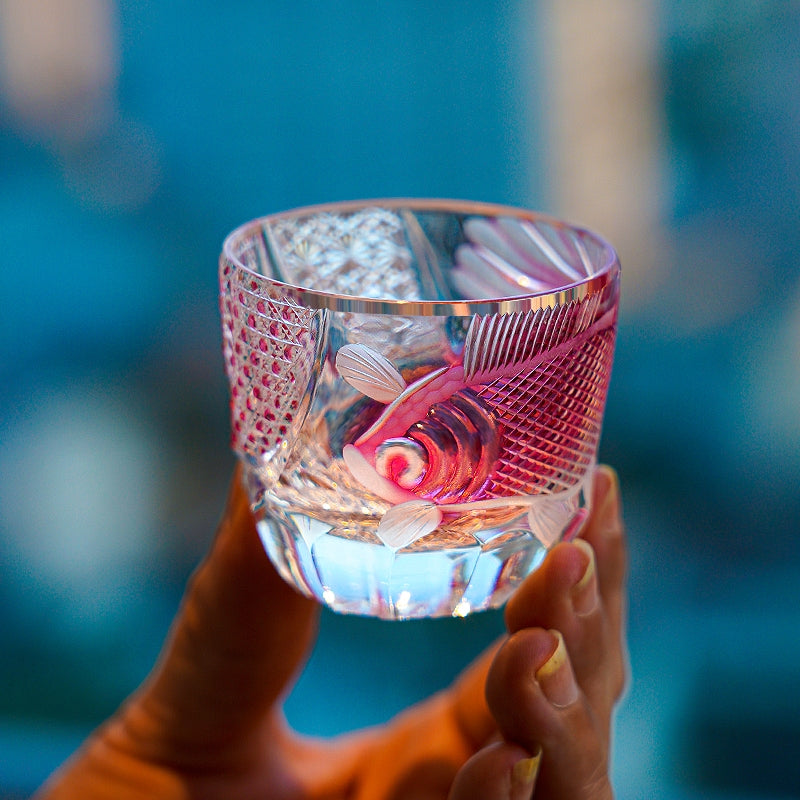
In a tradition known for its geometric precision and multi-colored layering, the Rose Koi Glass makes a bold departure. It is carved entirely in a single, vibrant hue—a deep, passionate rosy red that runs from rim to base without gradient, without interruption. This chromatic purity is not a simplification. It is a statement. By stripping away the complexity of multiple color layers, the artisan forces the viewer to confront something more elemental: the raw, unadorned dance between light and shadow, cut and reflection, emptiness and form. And at the center of that dance swims the koi—etched with meticulous care, suspended in a sea of crimson.
The Koi: Perseverance Made Visible
Before examining the glass, one must understand the symbol it carries. In Japanese and wider East Asian culture, the koi (carp) is revered not for beauty alone but for character. It swims upstream against powerful currents. It leaps at waterfalls. It endures where other fish would turn back. Thus, the koi symbolizes unwavering resilience in the face of adversity, the strength to overcome resistance, and the ultimate promise of "transformation through trial"—virtues that lie at the very heart of the spirit celebrated during "Boys' Day," when koi-shaped streamers flutter in the breeze beneath the bright spring skies.
To engrave the image of the koi upon *Edo Kiriko* glassware is, in essence, to fuse two distinct expressions of "resilience and endurance": the koi battling its way upstream through rushing currents, and the glass enduring the grinding abrasion of the cutting wheel. Having each withstood their own rigorous trials, both emerge utterly transformed—elevated to a state of profound sublimation.
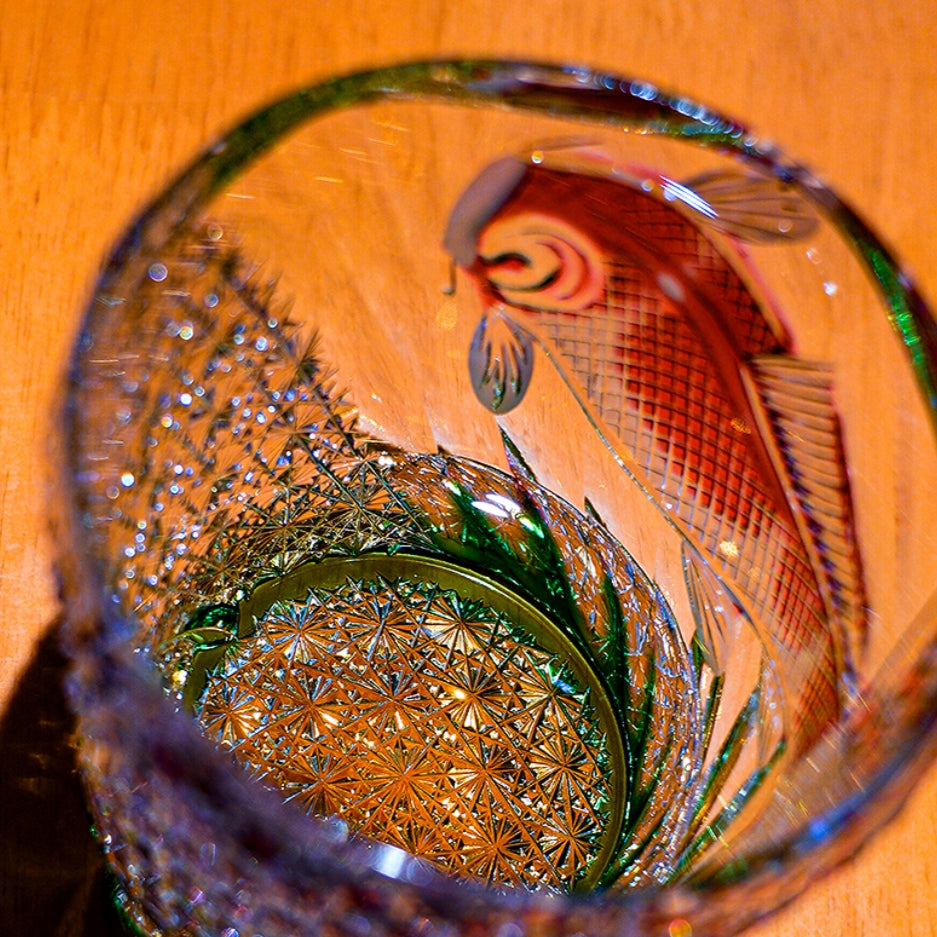
The Rose Koi Glass honors this parallel with extraordinary fidelity. The koi motif is not applied to the surface but excavated from it—layer by layer, facet by facet. The fish’s body curves along the contour of the glass, its fins spread as if pausing mid-stream. The scales are rendered not as individual marks but as a pattern of tiny diamond cuts that catch the light differently with every rotation. The eye—always the most challenging feature—is a single precise star-cut, no larger than a poppy seed, yet capable of catching a gleam from across a room.

The Power of a Single Color
Where the Sakura Supreme Collection and Kingyo Nishiki rely on the interplay between multiple fused layers, the Rose Koi Glass embraces the discipline of monochromatic depth. Working in a single rosy red presents unique challenges and unique opportunities.
The challenge herein lies in contrast. Lacking a second color to delineate boundaries, the artisan must rely entirely on the depth and angle of each individual cut to create layers and distinction. Shallow cuts produce a soft, diffuse reflection—much like the plump, rounded flanks of a koi; conversely, deep, sharp incisions carve out bright, crisp lines—precisely defining the edges of a fin or the graceful curve of a tail. The difference between a successful koi masterpiece and a mere amorphous blob of red often hinges on a margin of just a few tenths of a millimeter.
The opportunity, however, lies in the work's overall unity. The use of a single color allows the glass to manifest as a cohesive, integrated whole, rather than a mere stack of discrete layers. When light enters the "Rose Koi Glass," it travels through a homogeneous medium. The rose-red pigment selectively absorbs specific wavelengths of light while transmitting the rest, thereby creating a shifting, luminous glow within the glass itself—appearing as a deep, wine-like burgundy in the shadows, yet bursting into a vivid vermilion under direct illumination. The image of the koi is sculpted within this homogeneous field of color, as if gliding through an boundless crimson ocean—existing neither as a mere backdrop nor as an isolated foreground element, but rather as an intrinsic entity, inseparable from and of the very same essence as its surrounding environment.
This effect is most striking when the glass is filled. Pour a pale sake or a golden whiskey into the Rose Koi, and the liquid transforms the interior into a lens. The red crystal magnifies and warms the drink’s color. The koi appears to swim through the beverage itself, its scales rippling with every subtle motion of the glass. The experience is not merely visual but almost visceral—as if one held not a drinking vessel but a living creature in a crimson pond.
Patterns Within Patterns: The Geometry of Texture
Surrounding the central koi motif, the glass is carved with the intricate geometric patterns that define the Edo Kiriko tradition. These are not arbitrary decorations. Each pattern serves a specific purpose in the glass’s total effect.
The fine lattice—a grid of intersecting diamond-shaped facets—creates a textile-like texture across the lower bowl of the glass. Unlike the larger facets found on Western crystal, these tiny cuts are designed to scatter light rather than reflect it in a single direction. The result is a soft, diffused sparkle that suggests the shimmer of water surface or the glint of scattered fish scales. When the glass is still, the lattice pattern appears as a subtle texture. When rotated, it explodes into a field of tiny lights.
The star-cut textures—small, four-pointed facets placed at key intersections—function as anchors of brilliance.Each star-shaped facet acts like a miniature lens, gathering light from all directions and refracting it into concentrated beams. These facets are artfully arranged around the koi motif, collectively forming a dazzling "constellation of highlights" that guides the viewer's gaze as it traverses the entire composition. Visually, they resemble musical accents—brief, brilliant, and perfectly timed.
The base, too, receives full treatment. Unlike lesser cut-glass pieces where the bottom is left plain, the Rose Koi Glass features a radiating sunburst pattern carved into the solid foot. This serves both practical and aesthetic purposes: it provides grip against smooth surfaces, and it creates a burst of light whenever the glass is set down or lifted. Even at rest, the glass continues to perform.

Hand-Blown, Hand-Carved: The Artisan’s Signature
Every Rose Koi Glass begins its life as a lump of molten crystal, gathered on the end of a hollow steel pipe. The hand-blowing process is the first act of creation—the artisan shapes the rough form by breath and gravity alone, without molds or measurements. The blank must be perfectly symmetrical, perfectly free of bubbles or stress lines, and perfectly proportioned for the cuts to come.
Once cooled, the blank passes to the engraver—the master cutter who will spend days or weeks transforming it into a Rose Koi Glass. Using diamond grinding wheels of progressively finer grit, the engraver first establishes the primary contours: including the positioning and curves of the koi, the boundaries of the grid areas, and the placement of the star-shaped facets. This rough-cutting process removes the majority of the excess material, thereby revealing the basic composition of the piece.
Then comes the finishing cuts—the work that separates a competent piece from an extraordinary one. The fineness of the lattice, the sharpness of the star points, the smoothness of the koi’s curved surfaces—all depend on the engraver’s touch in this stage. The diamond wheels grow progressively finer, until the final polishing wheel, which leaves the cut surfaces brilliant and transparent rather than frosted.
Because every step is performed by hand and eye, no two pieces are exactly alike. On one piece of glassware, the curve of a koi might veer slightly to the left; on another, the lattice pattern may appear slightly more compact. These variations are not flaws, but rather unique "imprints"—proof positive that the vessel was shaped by human hands, rather than produced through the programmed precision of a machine. Collectors of Edo Kiriko particularly cherish these distinctions, regarding them as compelling evidence of an object's authenticity and individuality.
Compact Yet Captivating: Form and Function
The Rose Koi Glass is deliberately compact in scale—smaller than a typical whisky tumbler, larger than a traditional sake cup. This intermediate size is a conscious design choice. The glass is intimate enough to warm in the palm of one hand, yet substantial enough to hold a generous serving of spirits. It invites close inspection, personal connection, the quiet ritual of holding and turning and watching the light change.
For sake, the Rose Koi Glass is exceptional. The rosy red crystal warms the appearance of even chilled sake, creating a visual bridge between the drink’s purity and the glass’s passion. For whiskey, particularly a single malt with honey or fruit notes, the glass enhances both color and aroma—the red crystal seeming to pull out hidden complexities.
Yet the glass requires no liquid to captivate. Placed on a shelf, a desk, or a windowsill, the Rose Koi Glass functions as a unique art piece—a sculpture that changes with every shift of the sun. Morning light turns it bright and cheerful; evening lamplight deepens it to a brooding crimson. The koi is always present, always swimming, always reminding.
Eternal Crimson
The Edo Kiriko Handcrafted Rose Koi Glass is a timeless treasure—not because it will never change, but because it will always remind. Every time light strikes its facets, the koi swims again. Every time a hand wraps around its curves, the connection between ancient craft and modern life is renewed. Every time a drink is poured, the transformation occurs: from empty to full, from glass to experience, from object to memory.
This is the promise embodied by the "Rose Koi." Not perfection—for perfection belongs to machines—but rather *presence*: a tenacious constancy, a serene yet unshakable strength that compels it to swim ceaselessly, to shine without dimming, and to undergo an eternal, living transformation. Hold it up to the light, gaze upon its crimson, shimmering radiance, and you will understand: what you hold in your hands is far more than a mere vessel of glass.
What you hold in your hands is a vow, crystallized in glass.

Hinterlasse einen Kommentar
Diese Website ist durch hCaptcha geschützt und es gelten die allgemeinen Geschäftsbedingungen und Datenschutzbestimmungen von hCaptcha.