

A Field of Wildflowers on Your Table
In the late days of spring, a unique quality of light spills across the meadows of Scandinavia. It is neither the blinding, scorching glare of the Mediterranean sun, nor the soft, diffuse gray light characteristic of the English countryside. Rather, it is a light that is at once crystalline and vibrant—one that causes golden buttercups to glow, makes crimson poppies burn with fiery intensity, and sets azure cornflowers shimmering against a backdrop of deep green grass. It is a light that heralds the end of the long winter and the imminent arrival of warmth; it speaks of the vast, open skies, and of that simple yet profound joy inherent in the very act of being human.

The Nordic Countryside Underglaze Ceramic Dinner Plate captures this very light. It is a plate that does not whisper; it sings. Where much modern tableware retreats into safe, quiet monochromes—the off-whites, the matte greys, the restrained beiges—this piece dares to be different. It brings a burst of energy, a riot of color, and the untamed spirit of a wildflower field to the everyday ritual of eating. This is not a plate for hiding in a cupboard. It is a plate for celebrating.
The Philosophy: From Hygge to Hope
For years, the prevailing aesthetic in contemporary tableware design has been defined by a tone of "restraint." This is particularly true of Scandinavian design, which has become virtually synonymous with a minimalist, monochromatic style—characterized by clean, crisp lines, light-hued woods, and color palettes that rarely venture beyond the confines of black, white, and gray. Known as "Hygge," this style cultivates a spatial atmosphere that is both warm and soothing. Yet, the Scandinavian region harbors another, far older tradition—one that predates the advent of minimalist furniture and matte ceramics. It is a vibrant tradition of folk art: painted cabinetry, embroidered linens, and glassware rendered in vivid, bold, and exuberant primary colors. What this tradition celebrates is not merely comfort, but joy; not merely coziness, but a flourishing vitality and zest for life.
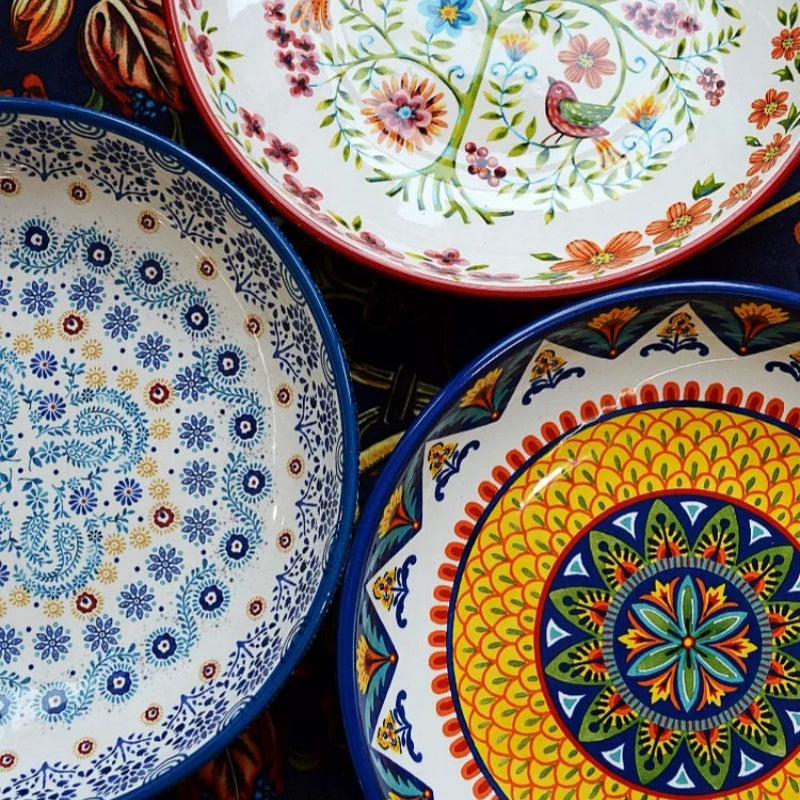
The Nordic Countryside collection returns to this older tradition. It replaces quiet stillness with lively, nature-inspired patterns in warm, inviting tones. The plate features hand-painted motifs of wildflowers, grasses, and leaves—not rendered with botanical precision, but with the free, expressive energy of folk art. The colors are unapologetically bright: sunflower yellows, berry reds, cornflower blues, and meadow greens. They do not compete with your food; they complement it, framing each meal within a circle of natural abundance.
This is the philosophy of the plate: optimism made tangible. Every time you set it on the table, it reminds you that beauty is not a luxury but a necessity, that color is not a distraction but a nourishment, and that the simplest meal—a bowl of soup, a piece of bread, a handful of berries—becomes a celebration when served with intention.

The Technique: Underglaze Storytelling
The plate's vibrant patterns are not printed on the surface, where they could scratch, fade, or wear away. They are created using the traditional underglaze technique—one of the oldest and most respected methods of ceramic decoration.
This process begins with an unfired clay plate—known as a "greenware" blank. The artisan uses specialized mineral pigments to paint wildflower motifs directly onto the surface of this coarse pottery. These pigments are ground from natural oxides: iron oxide is used to produce reddish-browns, cobalt oxide for blues, copper oxide for greens, and antimony oxide for yellows. Each color is mixed by hand and meticulously adjusted for both consistency and hue.
Once the painted design is complete and has dried, the plate is dipped into a transparent glaze—a liquid glass suspension that covers both the decoration and the bare clay. This glazed plate then enters the kiln for its first firing, typically at temperatures between 1,000°C and 1,150°C. During this firing, the glaze melts and fuses into a hard, glass-like layer. The underglaze pigments are permanently sealed beneath this protective coating.
The result is a decoration that is fired beneath the surface of the glaze, not on top of it. This offers two critical advantages. First, durability: the pattern cannot be scratched off, worn away by dishwashing, or degraded by acidic foods. Second, food safety: the glaze forms an inert, non-porous barrier between the colored pigments and your food. The plate is completely food-safe, with no risk of pigment migration.
Unlike industrial decals or digital prints, underglaze decoration carries the visible evidence of the human hand. Brushstrokes are not perfectly uniform. Colors bleed slightly at their edges. The composition has a spontaneity that no machine can replicate. Each plate is subtly unique—a one-of-a-kind expression of the artisan's touch.
The Material: Honest Earthenware
The plate is crafted from ceramic earthenware—a material fundamentally different from the fine porcelain or stoneware that dominates mass-produced tableware. Where porcelain is refined, translucent, and mechanically perfect, earthenware is rugged, opaque, and honestly imperfect.
Clay contains naturally occurring iron and mineral impurities, which impart a warm, rustic coloration—typically manifesting as soft milky white, light tan, or pale terracotta—depending on the specific composition of the clay itself. Because it is fired at lower temperatures than porcelain, this inherent warmth is preserved, while simultaneously endowing the finished dinnerware with a softer, more tactile surface texture.The material is naturally more rugged and textured than porcelain. It feels substantial in the hand, with a satisfying weight that speaks to its durability.
Crucially, the artisans who make these plates embrace the inherent characteristics of the clay rather than hiding them. Subtle black specks—tiny particles of iron or manganese naturally present in the clay—may appear on the surface. Tiny bumps or small pinholes may also be visible, particularly on the unglazed base of the plate. These features are not imperfections. They are not defects. They are the honest signatures of handmade pottery—proof that the plate was formed from real earth, not engineered from synthetic compounds.
In an age of digital perfection, these small irregularities are a quiet rebellion. They remind us that authenticity is more beautiful than flawlessness, that the human touch leaves traces, and that a plate made from actual dirt—fired, painted, glazed, and fired again—carries a dignity that no factory-perfect object can match.
The Design: A Burst of Nordic Nature
The plate's decoration draws directly from the Nordic countryside—not the manicured gardens of aristocratic estates, but the wild, self-seeded meadows that surround farmhouses and line country roads. The motifs include:
-
Wildflowers: These flowers are rendered with exuberant, expressive brushstrokes; rather than being botanically identifiable species, they serve as archetypes—the circular silhouette of a daisy, the clustered petals of a buttercup, the drooping, bell-shaped corolla of a campanula. Washed in warm, saturated hues, they appear to shimmer against a creamy, earthenware background.
-
Grasses and leaves: Fine, sweeping lines suggest the movement of grass in a summer breeze. These linear elements provide structure and rhythm, balancing the more rounded flower forms.
-
Scattered accents: Small dots, dashes, and stippled textures are scattered across the surface, suggesting seed heads, pollen, or simply the joyful abundance of a field in full bloom.
The composition is not symmetrical. It is not meant to be. A wildflower meadow does not arrange itself in perfect patterns. It grows where it pleases, spills over edges, and fills every available space with life. The plate's decoration follows this same logic—flowers appear on the rim, on the well, even occasionally on the underside of the plate. The pattern is not a border but a landscape, and you are meant to turn the plate as you eat, discovering new details with every rotation.
The Experience: From Everyday to Extraordinary
The Nordic Countryside plate is designed for everyday use. It is not a special-occasion piece to be brought out once a year and handled with trembling hands. It is meant to be used for Tuesday night pasta, Sunday morning pancakes, lunchtime sandwiches, and midnight snacks.
The plate is microwave safe, allowing you to reheat leftovers without transferring to another dish. It is dishwasher safe, making cleanup effortless even after the messiest meals. The underglaze decoration will not fade, and the glaze will not craze or cloud, even after hundreds of cycles.
But the true purpose of the plate is transformative. It takes the ordinary act of eating and elevates it. A simple bowl of soup becomes a meadow pool. A piece of quiche becomes a sunlit clearing. A handful of cherry tomatoes becomes a scatter of wild berries. The plate does not distract from your food; it frames it, sets it within a context of natural beauty, and invites you to eat with attention and gratitude.
Mixing and Matching: A Lively Table
The Nordic Countryside collection includes multiple pattern tones—variations on the wildflower theme in different color palettes. Some plates feature a warm, golden-yellow dominant hue. Others lean into berry reds and pinks. Still others emphasize cool blues and purples. This range is intentional.
The designers encourage you to mix and match different tones across your table setting. A golden plate next to a blue plate next to a red plate creates a visual energy that no matching set can achieve. The table becomes a meadow in miniature—diverse, alive, and endlessly interesting.
For larger gatherings, you can combine the dinner plates with matching salad plates, bowls, and serving pieces from the same collection. The result is a table that feels both curated and spontaneous, both intentional and free.
A Gift of Joy
Presented without elaborate packaging—the plate itself is the gift—the Nordic Countryside Underglaze Ceramic Dinner Plate is an ideal present for several kinds of recipients:
-
For the new homeowner beginning to build a kitchen collection, it offers beauty without fragility.
-
For the friend who loves to cook, it provides a canvas worthy of their creations.
-
For the person who has everything, it offers something they may not have: permission to use color, to embrace imperfection, and to find joy in the everyday.
More than an object, this plate is an invitation. It says: Slow down. Look closely. Notice the wildflowers. Eat with pleasure. Share with love. And remember that even the simplest meal, served on something beautiful, becomes a feast.
The Field on Your Table
This "Nordic Pastoral" underglaze ceramic dinner plate is anything but understated. It does not fade into the background, nor does it ever appear self-conscious of its own presence. Instead, it rests serenely upon your table, radiating a warm glow and commanding your gaze with an undeniable allure. Yet, amidst this striking presence, it bestows upon you a precious gift: a daily reminder—a reminder that the world is brimming with beauty; that wildflowers always grow freely, asking no permission; and, above all, that every single meal is a magnificent opportunity to celebrate the sheer joy of being alive.
Set your fork down. Turn the plate slowly. Watch the light catch the painted petals. And imagine, for a moment, that you are sitting in a Scandinavian meadow, with the sun on your face and a field of flowers stretching to the horizon.
That is the gift of this plate. Not just to hold your food, but to hold your imagination.
The Nordic Countryside Underglaze Ceramic Dinner Plate. Handcrafted. Hand-painted. Wild at heart.

Leave a comment
This site is protected by hCaptcha and the hCaptcha Privacy Policy and Terms of Service apply.