
Edo Kiriko Handcrafted Kingyo Nishiki Whisky Glass With Wooden Box

In an ancient workshop, just moments before twilight descends, the light turns a soft, golden hue. It is at this very instant that the master cutters—craftsmen of exquisite skill—lay aside their diamond grinding wheels; not to rest, but to observe. They lift each piece to the window, turning it slowly as they gaze upon the fading sunset piercing through the layers of glass. Amidst that interplay of light and shadow, a miracle unfolds: the goldfish carved within the crystal seem, against all odds, to come alive and swim.
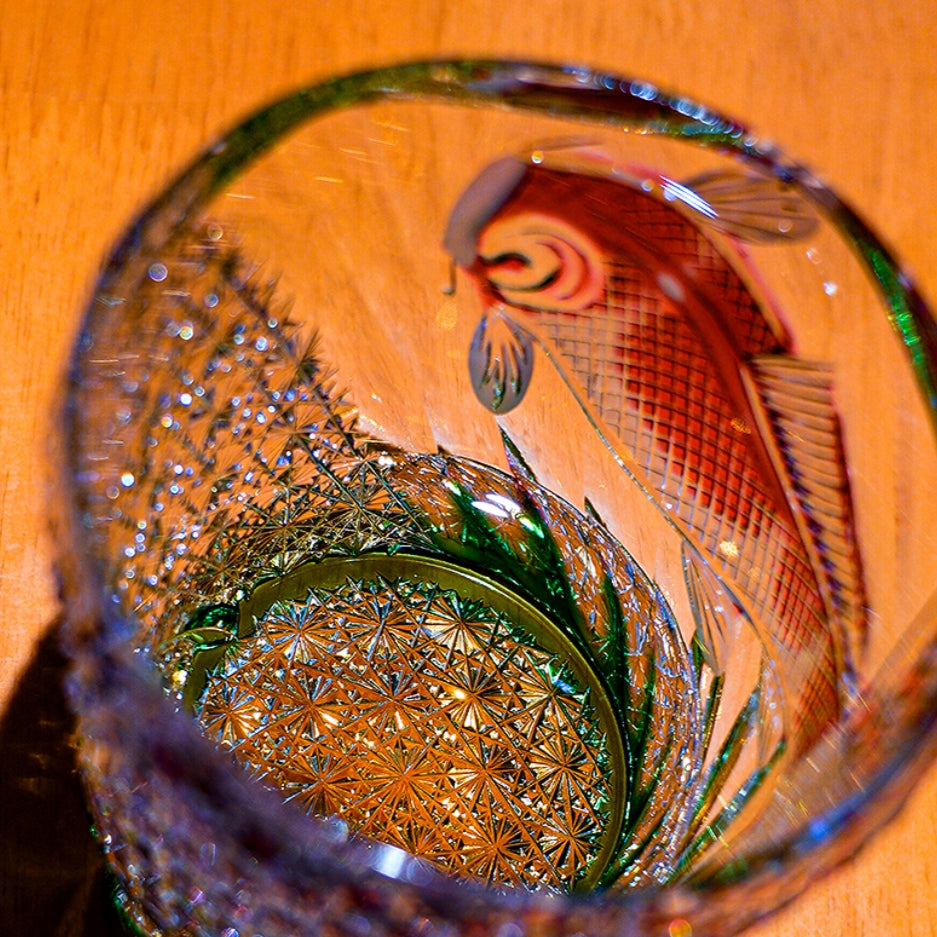
This is the Edo Kiriko Handcrafted Kingyo Nishiki Whisky Glass—a work that captures not merely a fish, but an entire current of Japanese cultural memory. The kingyo (goldfish) has for centuries been a beloved symbol of prosperity, flowing fortune, and quiet joy. To see one suspended in hand-cut crystal, caught mid-glide between layers of warm red and fresh green, is to witness a kind of frozen poetry. And like the fish itself, this glass demands to be seen in motion.
The Kingyo: A Symbol Set Free
In traditional Japanese culture, the goldfish carries layers of meaning far deeper than its delicate appearance suggests. Introduced from China centuries ago, the kingyo was initially kept only by aristocrats and samurai, who marveled at its shimmering colors. Over time, it became associated with summer festivals, romantic longing, and the Buddhist concept of nagare (flow)—the idea that fortune, like water, must move to remain pure.
Thus, engraving a goldfish onto Edo Kiriko glass signifies the simultaneous application of two distinct traditions: the geometric precision of glass-cutting craftsmanship and the organic, fluid beauty of living forms. The artisan faces a seemingly impossible challenge: how to depict vibrant life using a medium composed entirely of rigid angles and fixed planes?
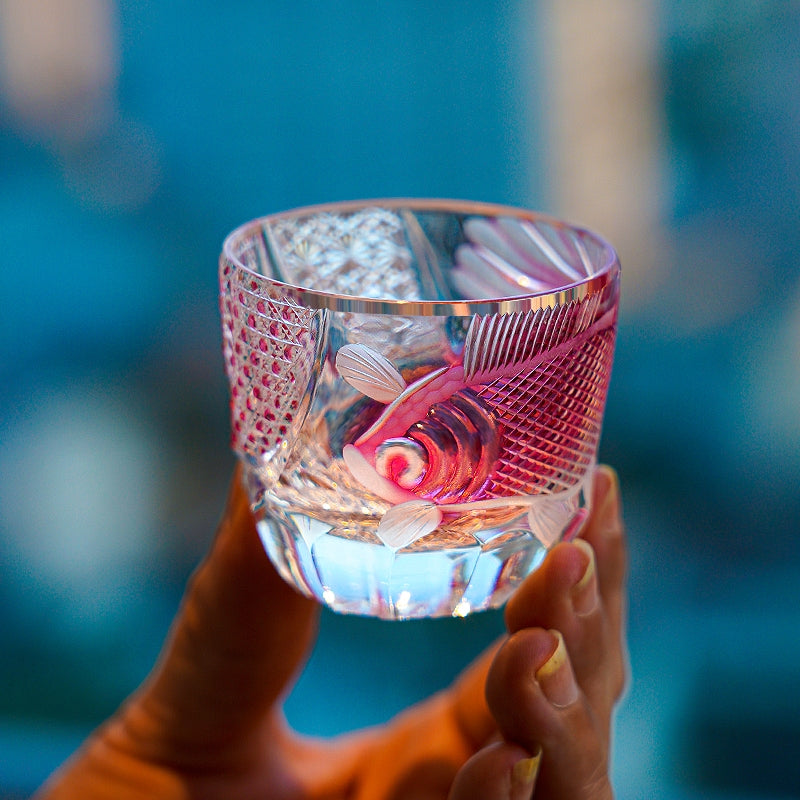
The answer lies in the composition of the *Kingyo Nishiki* (Goldfish Brocade). The fish motif is neither drawn nor painted; rather, it is brought to life entirely through the interplay of cutting depth and chromatic layering. Deep cuts delineate the curves of the tail, while shallower cuts suggest the rounded contours of the body; a series of minute, precise facets create the shimmering luster of scales. The fish does not merely rest upon the surface of the glass, but inhabits its very depths—encased within layers of warm crimson and cool emerald, as if suspended in a pool of light.
The Dance of Two Colors
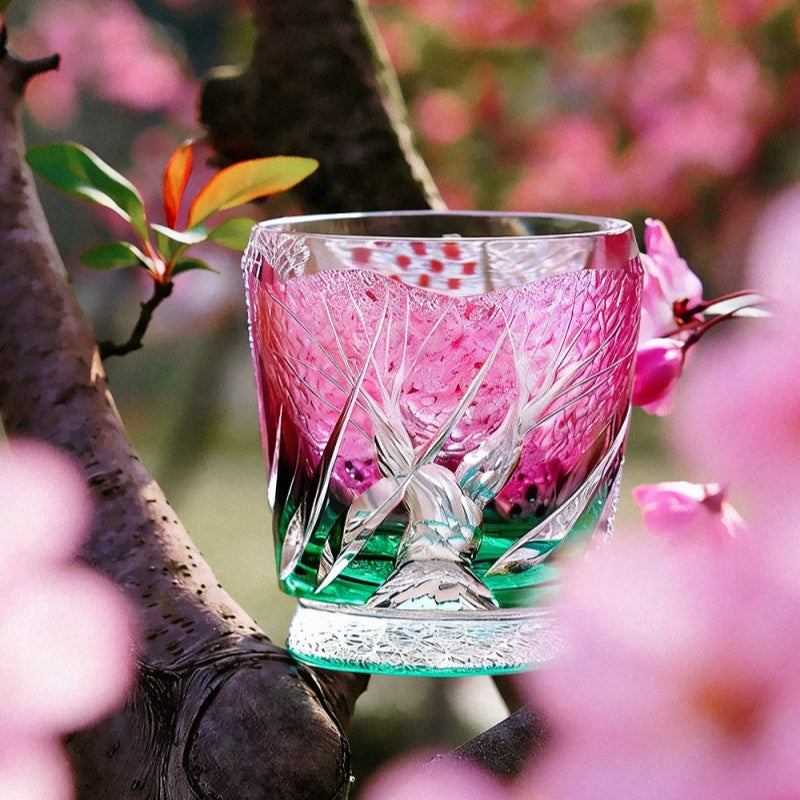
Where the Sakura Supreme Collection whispers of spring’s gentle romance, the Kingyo Nishiki sings with vibrant contrast. The color palette is bolder: a striking transition from beni-red—a deep, slightly orange-tinted crimson associated with celebration and good fortune—down into a midori base that evokes new growth, young bamboo, and the cool depths of a garden pond.
This gradient serves not merely as decoration, but rather as an extension of the fish itself. The red layer transforms into the goldfish’s own coloration—its warm back and luminous flanks—while the green base evokes the water’s surface, the shifting shadows, and the cool depths of the pond. As the light shifts, the boundary between the fish and its environment begins to blur. One moment, you see a goldfish gliding against a green backdrop; the next, it seems to have swum into deeper waters, its red silhouette merging seamlessly with the glass itself.
This visual ambiguity lies at the very heart of the Edo Kiriko craft. The two colors are fused within the furnace, rather than being layered after cutting; they share a molecular-level seam that the artisan must navigate with absolute precision in every single cut. Cut too deeply, and the red vanishes entirely, leaving only the green behind; cut too shallowly, and the fish lacks three-dimensional depth, floating instead like a faint, indistinct blush rather than appearing as a vibrant, living creature. A perfect cut strikes the precise balance at the point where red and green converge, allowing each color to enhance the other in perfect harmony.

The Geometry of Movement
Surrounding the central kingyo motif, the glass is carved with traditional Edo Kiriko patterns that serve both as ornament and as structural counterpoint. The fine lattice pattern—a grid of tiny intersecting diamonds—creates a textile-like texture that catches light in a thousand small sparkles. The star-cut textures—precise four-pointed stars carved into the crystal—act like tiny lenses, bending light into miniature rainbows.
The function of these geometric elements extends far beyond mere ornamentation; they imbue stillness with a sense of motion. As you rotate the glass in your hands, the checkered pattern shimmers and shifts, while the star-shaped facets flicker and glow like distant fireflies. Against this dynamic geometric backdrop, the fluid curves of the goldfish appear all the more vivid and distinct. The fish do not remain static; rather, they seem to glide through the geometric motifs, weaving their way through a forest of crystal.
It is precisely this dialogue between pattern and subject that elevates *Kingyo-nishiki* (Goldfish Brocade) far above ordinary cut glass. Most Western crystalware features patterns that blanket the entire surface of the vessel, often competing with one another for visual dominance. High-quality *Edo Kiriko* of this caliber, however, employs geometric motifs to serve as a foil—providing contrast and context—thereby accentuating the central design. The checkered grid does not confine the goldfish; on the contrary, it provides the very space in which the fish is free to swim.

Precision Carved by Hand
The creation of a single Kingyo Nishiki glass follows the same rigorous, entirely hand-executed journey as the Supreme Collection—over a dozen stages, from hot-blowing to final buffing. Yet the kingyo motif introduces unique challenges.
Unlike the sakura petal, which can be carved with relatively broad, sweeping cuts, the goldfish demands remarkable precision in the smallest details. The eye of the fish is typically rendered as a single star-cut—a minuscule four-pointed facet no larger than a grain of rice. The fins require cuts that taper from deep to shallow within millimeters. The curve of the tail—the kingyo’s most expressive feature—must flow without interruption across the natural curve of the glass wall.
These details are not planned on paper. Edo Kiriko masters do not work from blueprints. They draw pattern lines directly on the glass blank with a carbon pencil, one continuous stroke for each major element. The fish’s outline is drawn freehand, and no two are ever identical. The master then cuts along those lines, trusting a lifetime of muscle memory. A single tremor—a moment of distraction—and the line wanders. The fish becomes a carp, or nothing at all.
Weight, Balance, and the Ritual of Whisky
A whisky glass is ultimately a functional object, and the Kingyo Nishiki honors this truth. The weight is substantial and balanced—heavy enough to feel significant in the hand, but not so heavy as to fatigue. The solid base serves multiple purposes: it provides stability against tipping, it adds visual depth to the cut patterns (which continue onto the underside), and it acts as a thermal mass, keeping the whisky slightly cooler for longer.
The rim is polished to a smooth, rounded finish—not sharp like some cut glasses—so that drinking becomes a pleasure rather than a caution. The bowl is proportioned to concentrate the aromas of a fine single malt while leaving room for a single large ice cube or a finger of neat spirit.
When you pour whisky into the Kingyo Nishiki, something transformative occurs. The amber liquid fills the green base first, then rises into the red layer. Suddenly the goldfish is no longer floating in empty crystal. It swims in whisky—a golden pond that shifts and swirls with every movement. The lattice patterns refract the drink’s color, creating the illusion of depth within depth. The star cuts become points of amber light.
This is the moment the artisan works toward: not the glass on a shelf, but the glass in use. In motion. Alive.
A Gift in Wood and Light
The Kingyo Nishiki arrives presented in a traditional wooden box, as befits an object of this cultural significance. The box is not merely packaging but part of the experience—the scent of aged wood, the soft friction of the lid opening, the reveal of the glass resting in a custom-cut bed. To open the box is to participate in a ritual of appreciation that extends back centuries.
As a gift, the Kingyo Nishiki carries layered meanings. The goldfish wishes prosperity and fortune that flows like water. The red color celebrates joy and auspicious occasions. The green base wishes growth and fresh beginnings. The hand-cut craftsmanship speaks of patience, dedication, and the value of the handmade in an age of machines.
For whom is this gift intended? For the whisky drinker who has everything except something truly alive. For the collector who understands that symbolism and craft are inseparable. For the friend whose presence brings the same quiet joy as a goldfish gliding through summer light.
The Eternal Glide
Each piece of *Edo Kiriko* glassware represents a harmonious interplay—a concerto between the artist and the elements of nature, between fire and patience, and between the master craftsman’s hand and the crystal’s own spirit. The *Kingyo Nishiki* series, however, welcomes a unique collaborator: the goldfish itself—that spirited, shimmering little creature that has gracefully glided through Japanese poetry, paintings, and temple festival stalls for centuries.
As you cradle this glass in your hands, you hold far more than mere crystal. You hold an ancient tradition—an aesthetic sensibility adept at discerning life within the man-made, and capturing motion within stillness. Lift the glass toward the light. Gaze upon the goldfish, and observe how it catches a stray beam of sunlight. In that instant—in that breathtaking, suspended moment—it seems to truly come alive, as if swimming right before your eyes.
It is at that very moment that you will understand why the veteran craftsman wore a smile of deep satisfaction as he executed the final cut upon this *Kingyo Nishiki* glass. For what he created was not merely a vessel for drink, but the gift of freedom bestowed upon a goldfish.
The *Kingyo Nishiki* Whiskey Glass: Handcrafted *Edo Kiriko*. Flowing with good fortune, imbued with ethereal beauty, and crafted with timeless artistry.

Leave a comment
This site is protected by hCaptcha and the hCaptcha Privacy Policy and Terms of Service apply.