
What is the history of colored glass in Edo Kiriko?
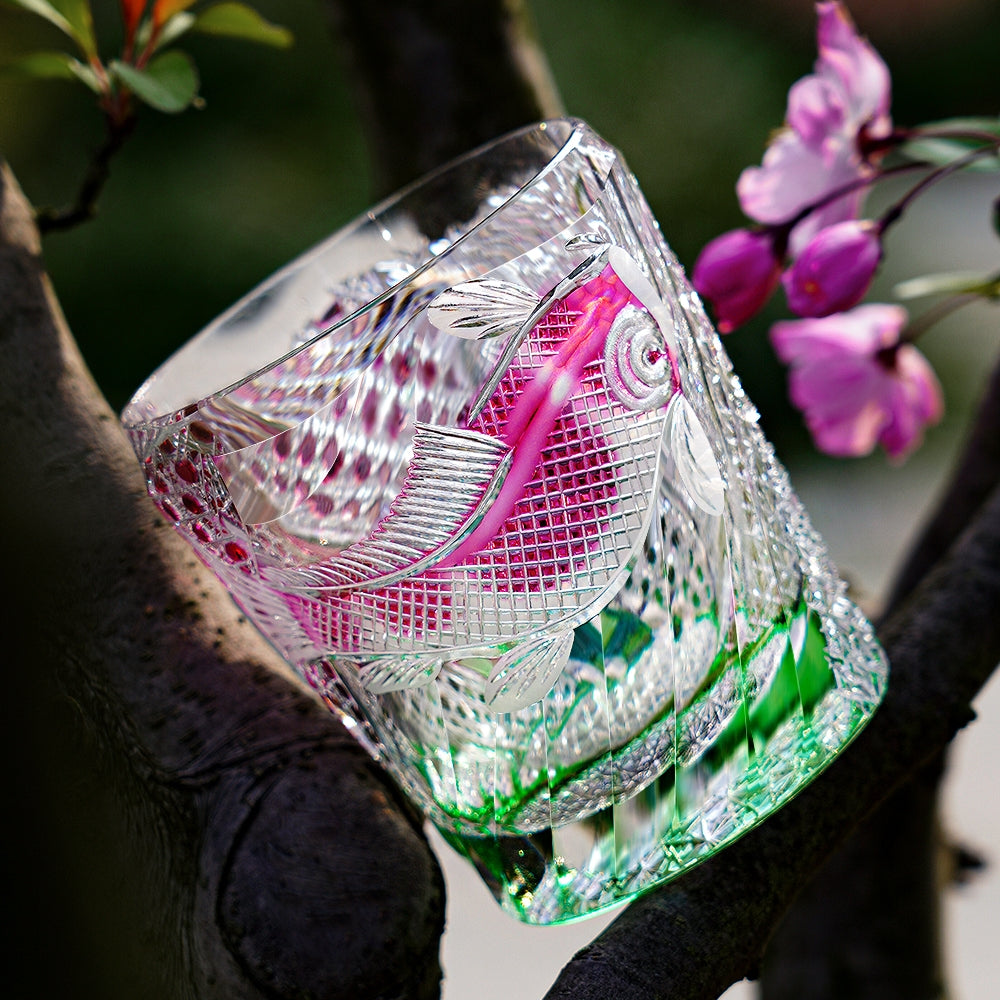
In the dazzling world of Edo Kiriko, colored glass is far more than a mere aesthetic choice; it is the very soul of the craft. It breathes life into exquisite cutting techniques, transforming the interplay of light and shadow into a breathtaking visual feast. Yet, this signature characteristic was not present from the start. The use of colored glass in Edo Kiriko represents an evolution from pure transparency to vibrant, multi-hued splendor—a journey shaped by foreign influences, indigenous innovation, and the unwavering dedication of Tokyo’s artisans.
The Transparent Origins: Edo Kiriko's Humble Beginning
In 1834, when the glass merchant Kagaya Kyūbei first experimented with engraving patterns onto glass in the Nihonbashi district of Edo, the material used was colorless and transparent. Early "Edo Kiriko" craftsmanship prized purity of form and precision of geometric structure; artisans carved bold, striking patterns into clear glass, creating visual effects derived primarily from the interplay of light and shadow rather than the use of color. This aesthetic, which emphasized transparency, resonated perfectly with the urban culture of Edo’s commoners, who valued simplicity and elegance.
The craft originated from an admiration for Western cut glass introduced to Japan through trade. However, Japanese artisans were not content with mere imitation; instead, they actively incorporated foreign influences to elevate the craft into a uniquely indigenous art form. Although the technical foundations were firmly established by that time, the aesthetic style remained characterized by a monochromatic palette.
The European Catalyst: A Chromatic Revolution
The pivotal moment for colored glass in Edo Kiriko arrived with the Meiji Restoration. In 1881, the Japanese government established a Western-style glass factory in Shinagawa, Tokyo, and invited British glass expert Emmanuel Hauptmann to introduce advanced European cutting techniques. This period of intense technological exchange brought not only new tools and methods but also new aesthetic possibilities.
The European influence on colored glass was profound. Satsuma Kiriko, Edo Kiriko's southern counterpart, had already begun experimenting with overlaid colored glass in 1849, but its production lasted only about thirty years before declining. The techniques involved—layering colored glass over a clear base—drew on Central European traditions with precedents in Bohemia, Russia, Belgium, and France. Edo Kiriko artisans observed these innovations and adapted them, preserving their own aesthetic identity while embracing the chromatic possibilities.
The Birth of Irokise: A Two-Layer Wonder
The technique that would define modern Edo Kiriko is called irokise (color-coated glass). The process begins with an expert glassblower creating a two-layered structure: a clear crystal interior encased in a thin veneer of colored glass, typically less than one millimeter thick. This method, known as pokan (named for the sound made when removing the glass from the kiln), produces a piece with a transparent interior and a vibrant exterior surface.
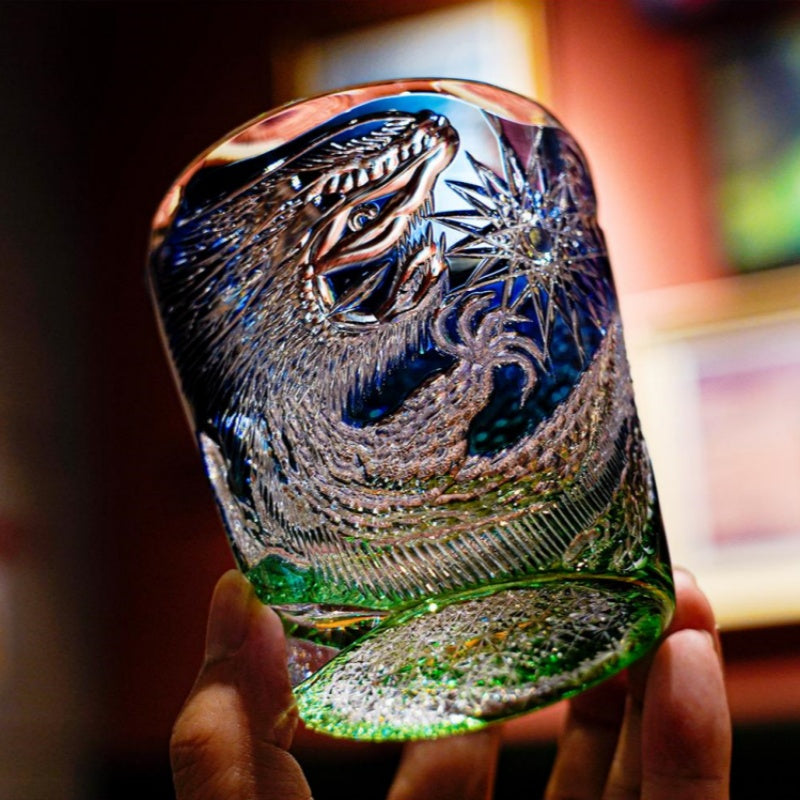
The innovation of irokise transformed Edo Kiriko from a craft of subtle geometry to one of dramatic contrast. When the artisan's wheel cuts through the colored overlay, it reveals the clear crystal beneath, creating a vivid interplay between the two layers. The deeper the cut, the brighter the gleam of the inner crystal; the more intricate the pattern, the more complex the play of light. This contrast—the vibrant outer color meeting the luminous clarity within—became the very essence of Edo Kiriko's aesthetic appeal.
The Coloring of Craft: Pigments and Precision
The colors that distinguish Edo Kiriko are not merely decorative—they are the result of precise chemical formulations. The colored glass overlay is created using precious metal oxides: cobalt for blue, gold for ruby red, copper for green, and manganese for purple. The vibrant, stable colors that define the finest Edo Kiriko rely on these costly additives, and the failure rate in producing layered blanks is substantial—any flaw in the fusion renders the entire piece unusable.
The color application itself is a technical challenge that requires exceptional skill. The glassblower must maintain precise temperature control to fuse the two layers without bubbles, stress lines, or separation. The resulting colored layer is exceptionally thin—Edo Kiriko's colored glass is cut to a thickness of less than 1mm, compared to Satsuma Kiriko's 2mm to 3mm, creating a sharper, more delicate brilliance.
Modern Innovation: Beyond Tradition
The history of colored glass in Edo Kiriko is not confined to the past. Contemporary artisans continue to push the boundaries of the craft. Kingo Nakamura, founder of Nakakin Glass Inc., was the first person in Japan to develop the pokan method, a technique for crafting layered colored glass that involved blowing a thin layer of colored glass on the outer surface, placing it into a specially heated kiln, and then blowing glass of another color onto the inside. This innovation contributed significantly to the growing popularity of Edo Kiriko in the post-war period.
Today, artisans like 4th-generation master Kohei Kobayashi are developing original processes that combine traditional Edo Kiriko techniques with kilnworking, producing pieces that are truly one-of-a-kind. The craft continues to evolve, with approximately 80% of Edo Kiriko manufacturing now occurring in Tokyo's Koto and Sumida Wards.
Recognition and Legacy
In 1985, Edo Kiriko was designated a "Traditional Craft Industry of Tokyo," and in 2002, it was recognized as a "National Traditional Craft." These designations cemented the status of colored glass as a core characteristic of Edo Kiriko—demonstrating that it is not merely a borrowed foreign technique, but an element fully integrated into, and indispensable to, Japan's cultural heritage.
The evolution of colored glass in Edo Kiriko mirrors the broader history of Japanese craftsmanship: the process of absorbing foreign influences and transforming them into an art form with a distinctively Japanese character. What began as a craft featuring simple, transparent geometric patterns evolved—through the adoption of European techniques and the incorporation of local innovations—into an exquisite art of color. Today, as light passes through the colored layers of an Edo Kiriko piece, it reveals not only the beauty of light and shadow but also a legacy spanning nearly two centuries of cultural exchange, technical refinement, and an unwavering pursuit of beauty.

Dejar un comentario
Este sitio está protegido por hCaptcha y se aplican la Política de privacidad de hCaptcha y los Términos del servicio.