
Why is Edo Kiriko so expensive?
In the realm of luxury tableware, few items command as high a price as "Edo Kiriko" cut glass. A single whiskey glass can cost hundreds of dollars, while exquisite masterpieces intended as heirlooms may fetch thousands. To the uninitiated, spending such a significant sum on a glass featuring what appear to be merely decorative patterns might seem extravagant; however, understanding the pricing of Edo Kiriko requires appreciating the many elements behind it: rare materials, exceptional craftsmanship, profound cultural heritage, and an artisanal legacy honed over nearly two centuries. Its high price is not merely a symbol of prestige, but the cost of an unrelenting pursuit of perfection.
The Raw Materials: The Foundation of Excellence
The creation of an Edo Kiriko piece begins with the meticulous selection of premium materials. Each item is crafted from high-quality crystal, typically containing over 24% lead oxide. This choice is by no means a cost-saving measure; in fact, due to the higher cost of raw materials and the more demanding melting process, lead crystal is significantly more expensive to produce than soda-lime glass. The lead content plays a crucial role: it increases the glass's refractive index, causing light to refract more intensely and producing the brilliant sparkle characteristic of the Kiriko craft. Without this optical property, the deep, intricate cuts would appear dull and lifeless, failing to reveal that breathtaking, dazzling quality.
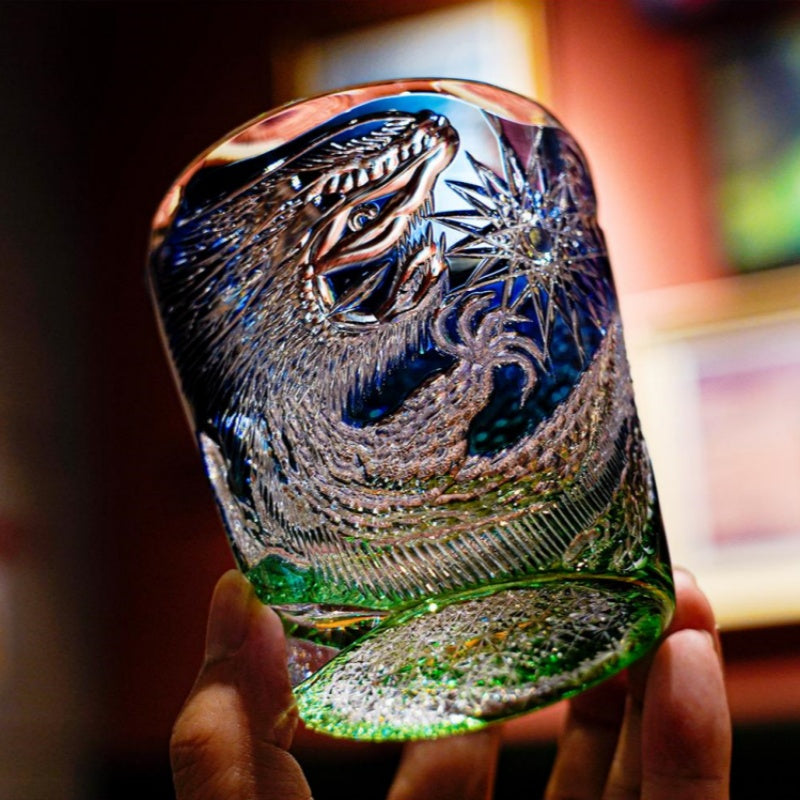
Even more costly is the irokise technique, which requires a two-layered structure—a clear crystal interior encased in a thin veneer of colored glass. Creating this layered blank is a feat of glassblowing skill, demanding exceptional temperature control to fuse the two layers without bubbles, stress lines, or separation. The colored glass itself contains precious metal oxides: cobalt for blue, gold for ruby red, copper for green, and manganese for purple. These are not inexpensive pigments; the vibrant, stable colors that distinguish the finest Edo Kiriko rely on these costly additives. The failure rate in producing these layered blanks is substantial—any flaw in the fusion renders the entire piece unusable, and the artisan must begin again from molten raw materials.
The Labor: Time as the Ultimate Currency
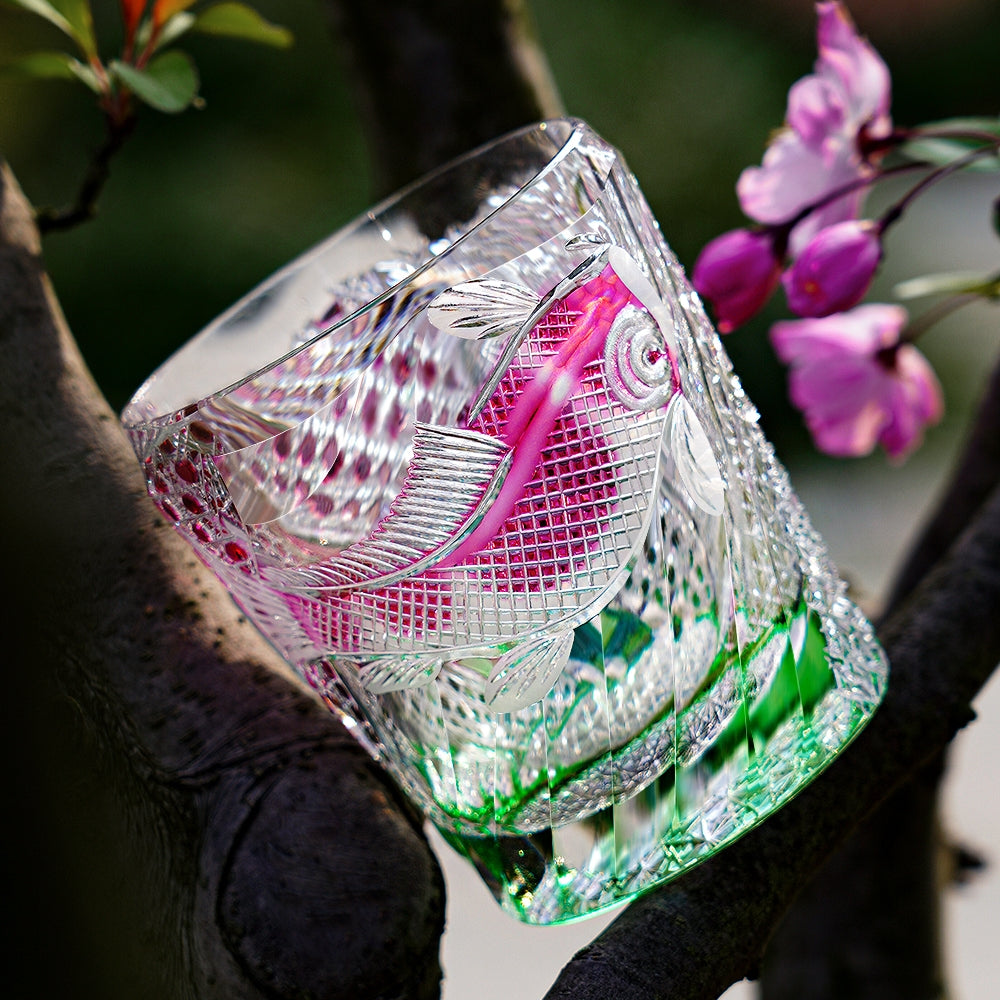
The largest component of the cost of Edo Kiriko glassware is the labor required to create each piece. The cutting process is performed entirely by hand—relying not on digital controls or automated machinery, but solely on the artisan's trained eye and steady hands. Depending on the complexity of the pattern, a single piece takes between 10 and 25 hours to complete; for highly intricate designs featuring delicate, figurative motifs—such as flying fish—the production time can exceed 30 hours.
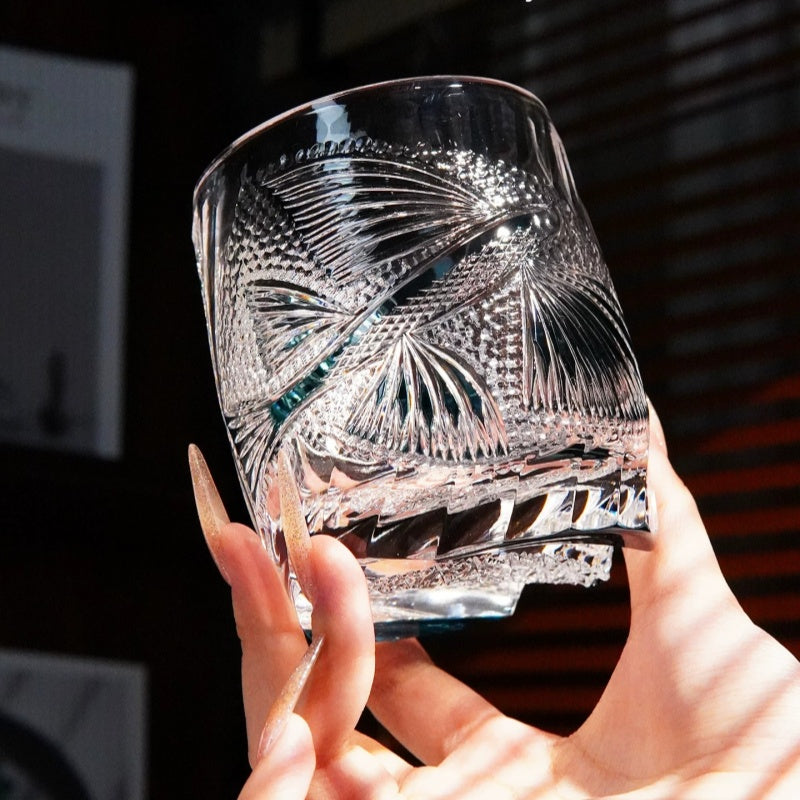
The process unfolds in distinct stages, each demanding a different skill set and level of precision. The rough cutting stage uses coarse emery wheels to establish the primary outlines. This is the moment of greatest risk: once the wheel touches the glass, the design becomes permanent, and any error is irrecoverable. The detailed cutting stage follows, employing increasingly fine abrasives to refine the contours, create textural depth, and execute the delicate undercuts that give the design its sense of volume and motion. The polishing stage—perhaps the most painstaking—uses natural whetstones from southern Japan, then wooden wheels of paulownia or willow, and finally soft cloth buffers with fine polishing compounds. Each stage removes progressively smaller amounts of glass while returning the surface to brilliant transparency.
This labor cannot be accelerated or automated. The artisan must work at a pace dictated by the materials; rushing leads to fractures, uneven cuts, or loss of the optical brilliance that distinguishes the craft. The work is physically demanding, requiring intense concentration for hours on end, often in conditions of heat and airborne glass particles. The cumulative wear on the artisan's body—particularly the eyes and hands—limits the number of pieces a craftsman can produce in a week, typically no more than three or four for complex designs.
The Training: Decades to Mastery
The price of Edo Kiriko reflects the immense investment of human capital required for its creation. Cultivating a master artisan often takes decades rather than mere years. In traditional workshops, apprentices spend their initial years learning to handle tools, observing their mentors, and practicing cuts on scrap glass to develop the necessary hand-eye coordination. They must perform thousands of practice cuts before being permitted to work on pieces intended for sale; even then, they remain under supervision and guidance at every stage of the process.
Mastering this craft demands not only technical excellence but also an intuitive understanding of how light interacts with cut surfaces of varying depths and angles. The most accomplished artisans do not rely on detailed blueprints while working; instead, they create based on mental concepts honed through years of practice. Before the grinding wheel touches the glass, they must visualize the final outcome of each cut, anticipating how light will penetrate the colored outer layer and refract from the clear inner layer. Such intuitive judgment cannot be taught in a classroom; it is truly grasped only through years of accumulated experience, the tempering effect of setbacks, and the continuous refinement of one's skills.
Japan recognizes these artisans through a system of certification, with the highest level—holders of Important Intangible Cultural Properties—carrying the accumulated knowledge of generations. The scarcity of such trained artisans is a critical factor in pricing. In 2024, fewer than 100 certified Edo Kiriko artisans are active in Tokyo, the craft's historic heartland. The craft is designated a Tokyo Traditional Craft Industry and a National Traditional Craft, restrictions that ensure the tradition remains in the hands of dedicated practitioners rather than mass producers.
The Heritage: Two Centuries of Unbroken Tradition
Edo Kiriko traces its lineage to 1834, when glass merchant Kagaya Kyūbei first began cutting patterns into glass in Tokyo's Nihonbashi district. For nearly two centuries, this tradition has been transmitted from master to apprentice, surviving the Meiji Restoration, two world wars, the devastation of the 1923 Great Kanto Earthquake, and the relentless advance of mass production. The craft was designated a Tokyo Traditional Craft Industry in 1985 and a National Traditional Craft in 2002, cementing its status as a cultural treasure.
To own a piece of Edo Kiriko is to participate in this living heritage. Each piece carries the signature of the artisan who made it and is presented in a paulownia wood box that serves as both protection and testament. The collector acquires not just an object but a link to a continuum of human creativity that has been sustained through immense historical pressures. This intangible value—the sense of connection to tradition—adds a dimension that purely functional glassware cannot replicate.
The Artistry: Unique and Irreplaceable
Another key factor in the cost of Edo Kiriko is the uniqueness of each piece. Because the cutting is entirely manual, no two pieces are exactly identical. Even when following the same design, each artisan brings their own interpretation—slight variations in depth, angle, and finish that mark each piece as unique. In an era of industrial production, where millions of identical glasses can be manufactured at minimal cost, this individuality is increasingly rare and increasingly cherished.
The Masterpiece Edo Kiriko Flying Fish Whisky Glass exemplifies this artistic dimension. The design captures a fish mid-leap through deep, sweeping cuts that suggest explosive motion. The translucent blue exterior is carved away to reveal the clear crystal beneath, creating a dramatic contrast that makes the fish appear to glow from within. The design is not merely decorative but transformative—it turns glass into a prism that renders light as narrative. Such artistic ambition requires a level of skill that commands premium pricing, as only a handful of artisans possess the ability to execute it successfully.
Conclusion: The True Measure of Value
Is Edo Kiriko expensive? By conventional standards, yes. A single glass may cost what an entire set of machine-made crystal would cost. But these prices reflect the true cost of producing objects of enduring beauty and cultural significance: the rare materials, the decades of training, the hours of concentrated labor, the continuity of a living tradition, and the irreplaceable individuality of each piece. To pay for Edo Kiriko is not to buy a glass but to commission a piece of living history, an investment in a craft that has survived against all odds, and a vessel that will continue to sparkle for generations, a frozen moment of human artistry set in crystal.

Leave a comment
This site is protected by hCaptcha and the hCaptcha Privacy Policy and Terms of Service apply.