
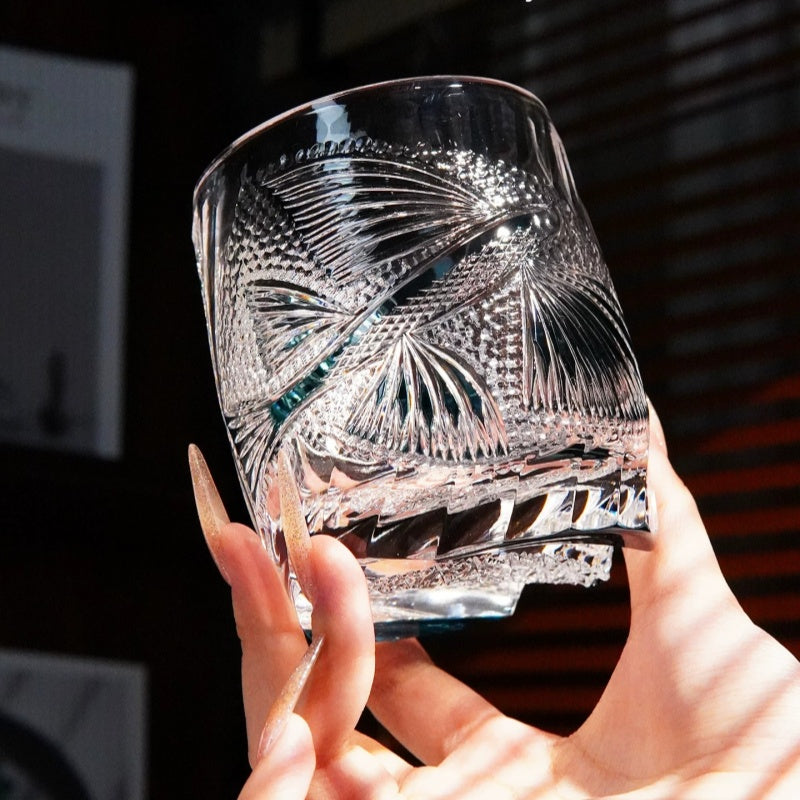
Are Edo Kiriko glasses good?
When considering the purchase of luxury glassware, a question inevitably arises: Is Edo Kiriko glassware truly worth the investment? The answer lies not merely in metrics of quality, but in understanding the deeper significance embodied by these extraordinary vessels—they are the culmination of nearly two centuries of challenging, ever-refining craftsmanship; the embodiment of an aesthetic philosophy that celebrates the interplay of light and shadow; and a tangible link to a time-honored tradition that remains vibrant to this day. To evaluate Edo Kiriko is, in essence, to evaluate the craftsmanship itself.

The Technical Excellence: What Sets Edo Kiriko Apart
The superiority of Edo Kiriko begins with the raw material. Each piece begins as high-quality crystal, typically composed of silica, lead oxide, and potassium carbonate. The lead content—often exceeding 24%—is not merely a historical relic but a functional choice: lead crystal possesses a higher refractive index than ordinary glass, meaning it bends light more dramatically. This property is essential to the Kiriko aesthetic, as the deep cuts reveal brilliant sparkle that cheaper glass cannot replicate. The crystal is then hand-blown into a two-layered structure known as irokise—a clear interior encased in a thin veneer of colored glass. This dual-layer construction is technically demanding and economically costly, but it creates the luminous contrast that defines the art form.
It is the cutting process itself that truly distinguishes Edo Kiriko from its machine-made counterparts. Industrial glass processing relies on automated diamond wheels following digital patterns; while the resulting products are uniform, they often lack depth and character. In contrast, Edo Kiriko artisans work without blueprints, guided only by faint guide lines traced in red iron oxide on the glass surface. This manual artistry cannot be replicated by machines—not due to technical limitations, but because the artisan’s mastery of depth, angle, and light refraction stems from intuition honed over years of practice, rather than mere numerical calculation.
The evidence of this quality is immediately tangible. A genuine Edo Kiriko glass has a reassuring weight—typically between 350 and 450 grams—that signals solid construction. The cuts are sharp and precise, yet polished to a smoothness that feels luxurious to the touch. When gently tapped, the crystal produces a clear, resonant ring that fades slowly, a sonic signature of lead crystal's internal density. And when held to light, the piece reveals an almost kaleidoscopic brilliance, with each cut surface catching and dispersing light in a unique way.
The Aesthetic Dimension: Beyond Function to Art
Technical excellence alone does not explain the devotion that Edo Kiriko inspires. These glasses are objects of profound aesthetic contemplation. The patterns—whether geometric Asanoha (hemp leaf), Tatewaku (rising steam), or representational motifs like the flying fish—serve a dual purpose. On the surface, they decorate; at a deeper level, they manipulate light to create the illusion of depth, motion, and inner radiance.
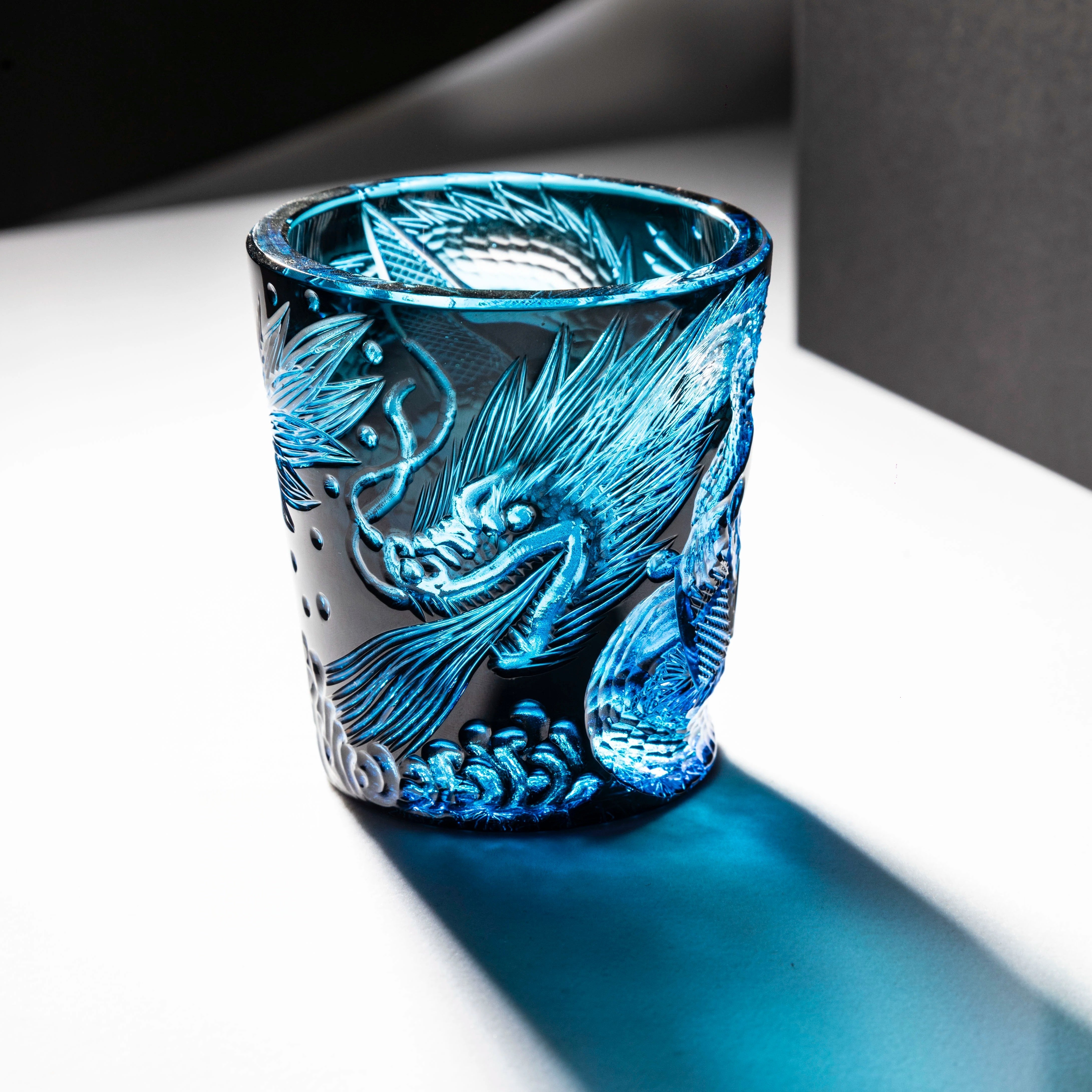
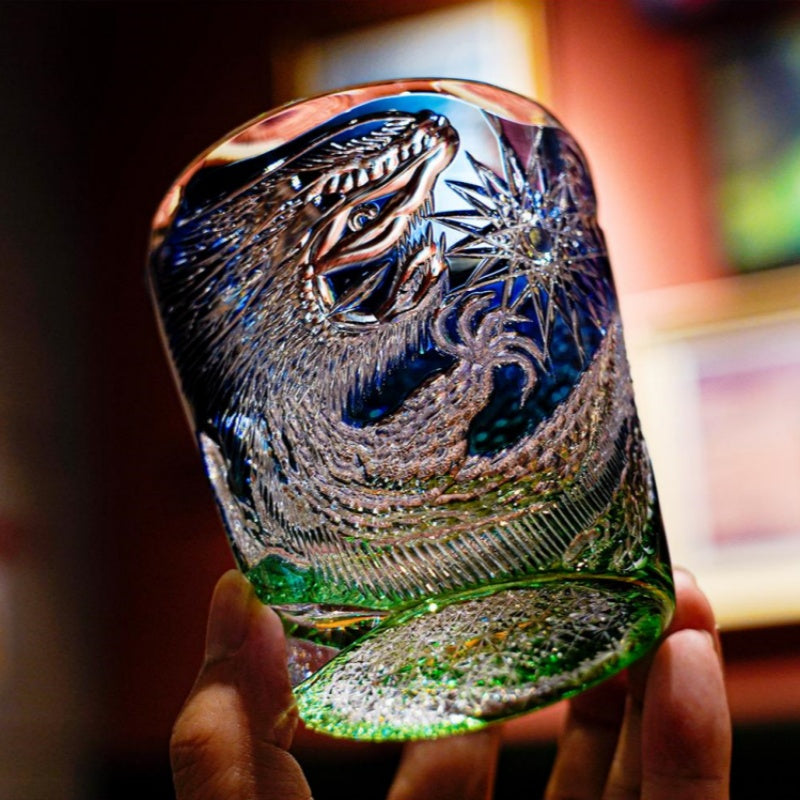
The "Flying Fish" Edo Kiriko whisky glass is a perfect embodiment of these qualities. The design at the center of the glass captures the precise moment a flying fish leaps from the water; deep, fluid cuts imbue the image with explosive dynamism. Meticulous carving of the translucent blue outer layer reveals the clear crystal beneath, creating a striking contrast of light and shadow that makes the fish appear to glow from within. As the glass turns, the fish seems to come alive and swim: its fins shimmer with shifting light and shadow, its body oscillates between bold contours and delicate textures, and the spray trailing behind transforms into a myriad of sparkling, radiant facets.
What makes this particular design so successful is its understanding of the medium. The artisan has not merely carved a fish into glass; they have used the physical properties of crystal to suggest the fish's very essence—speed, freedom, and the defiance of gravity. The deep undercuts create shadows that enhance the sense of volume; the fine textural lines suggest scales and dorsal ridges; the radiating base pattern grounds the composition while providing a spectacular foundation of refracted light. This is not decoration but transformation—the glass becomes a prism that turns ordinary light into an ever-changing spectacle.
The Human Factor: Craftsmanship as Heritage
The value of Edo Kiriko extends beyond the object itself to the person who created it. Each piece is certified by the artisan who made it, often accompanied by a signed paulownia wood box that serves as both protection and testament. The training required to reach this level is measured in decades, not years. Apprentices spend years simply learning to handle the tools before they are permitted to cut actual glass. The finest artisans, recognized by the Japanese government as holders of Important Intangible Cultural Properties, carry the accumulated knowledge of generations—techniques that have been refined since 1834, when Kagaya Kyūbei first began cutting glass in Tokyo's Nihonbashi district.
This human element is what makes each Edo Kiriko glass unique. Despite the disciplined technique, no two pieces are identical. Subtle variations in depth, angle, and polish mark each glass as the product of a particular artisan's hand on a particular day. In an age of mass production, this individuality is increasingly rare and increasingly precious. To own an Edo Kiriko glass is to participate in a relationship—with the artisan, with the tradition, and with the countless connoisseurs who have appreciated this craft over nearly two centuries.
A Recommendation: The Flying Fish as the Ideal Entry Point
For those considering their first acquisition, the Masterpiece Edo Kiriko Flying Fish Whisky Glass represents an exceptional starting point. It embodies every virtue of the craft: the technical precision of the cutting, the dramatic beauty of the irokise layering, and the poetic resonance of a motif that speaks to universal themes of aspiration and freedom. It is also a supremely functional object, designed with the whisky enthusiast in mind—weighted for stability, balanced for comfort, and shaped to allow the spirit to breathe.
The Flying Fish design is particularly well-suited to contemporary tastes, offering a bold, dynamic aesthetic that feels both traditional and distinctly modern. It commands attention on the shelf, yet it is equally at home in the hand during a quiet evening pour. And unlike the purely decorative specimens sometimes produced by lesser makers, this glass is built for use—to hold, to pour, and to admire through the lens of fine whisky.
Conclusion: The Verdict
Are Edo Kiriko glasses good? The answer is an unequivocal yes—provided one understands what "good" means in this context. They are not merely functional vessels; they are works of art that happen to be usable. They are investments not in status but in beauty, not in utility but in the enduring human desire to transform raw materials into objects of meaning. The Masterpiece Edo Kiriko Flying Fish Whisky Glass exemplifies this ideal: a tradition-made-tangible, a frozen moment of flight, and a luminous companion for life's reflective moments. For those who value craftsmanship, aesthetics, and heritage, there is no better choice.

Dejar un comentario
Este sitio está protegido por hCaptcha y se aplican la Política de privacidad de hCaptcha y los Términos del servicio.