





Edo Kiriko Handcrafted The Stardust Crystal Whisky Glass with Wooden Box
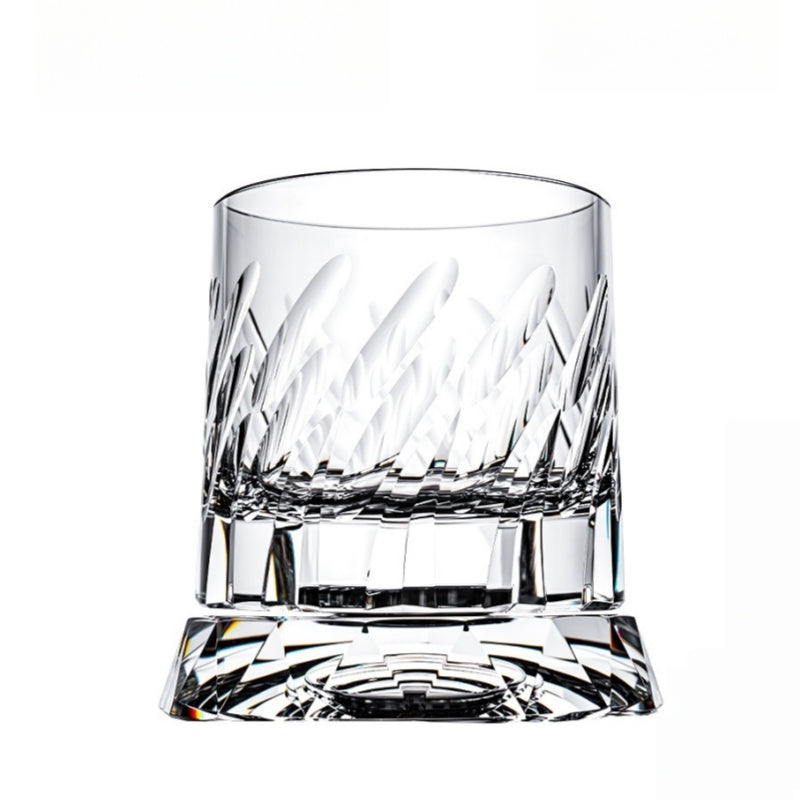
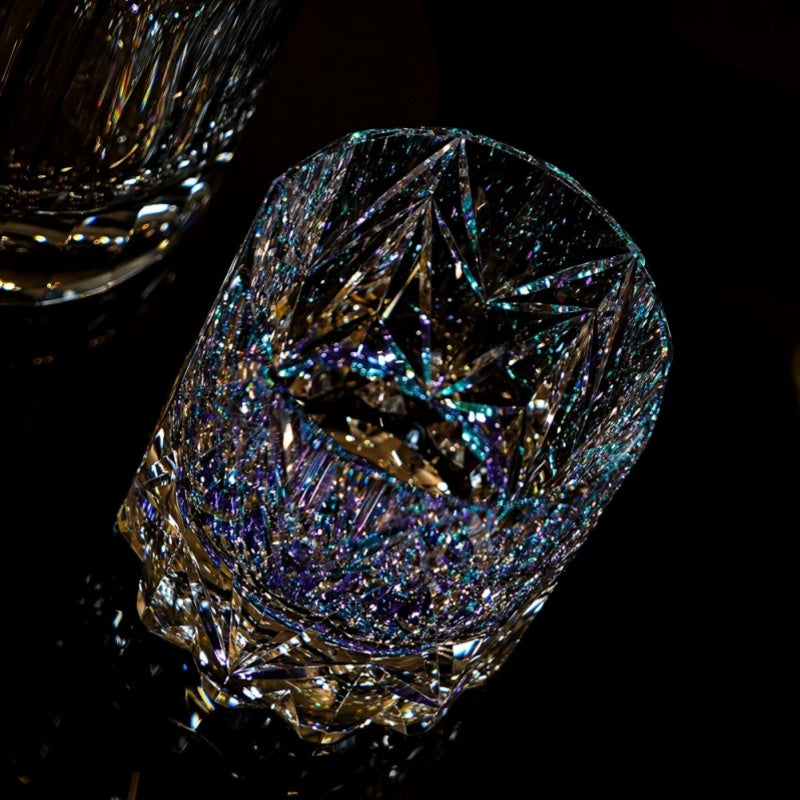
The Stardust Whisky Glass carries a hand-cut sword-leaf pattern into lead-free K9 crystal, a lattice of clean, straight folds that meet like the closing edge of a blade. Each line is cut deep and even at the diamond wheel, its ridge distinct, and the pattern rises from the foot in tiers until it opens into clusters of sparks. Nothing is pressed or molded into the surface. The pattern is cut, one pass at a time, and its discipline is visible from across the room.
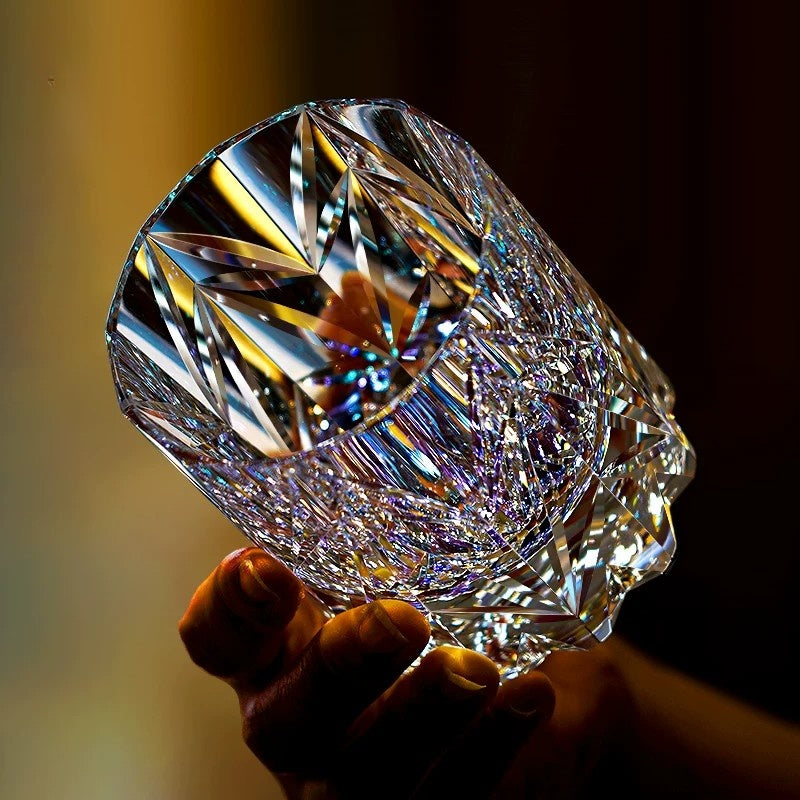
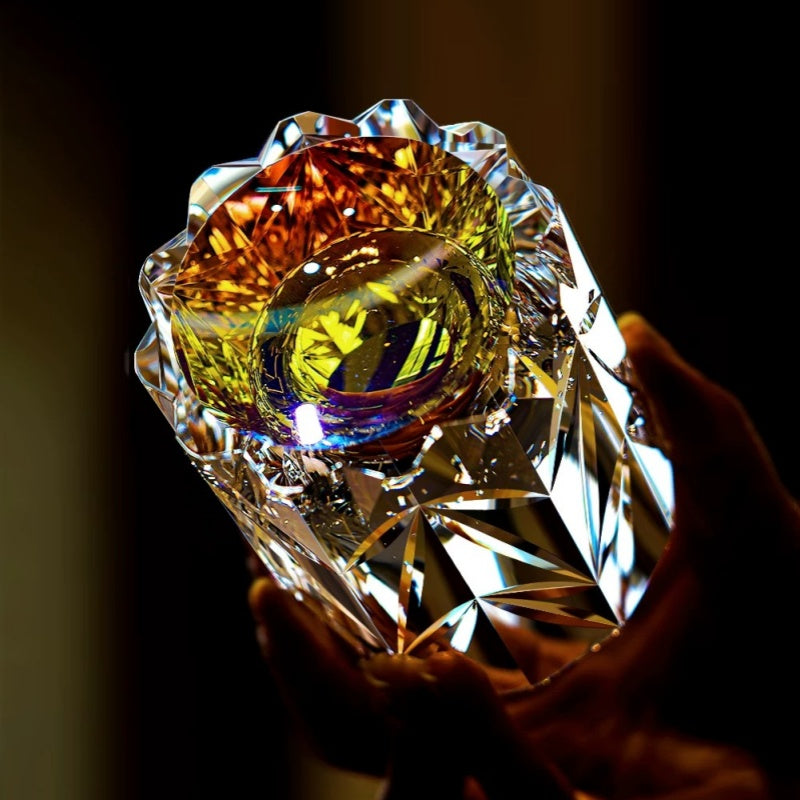
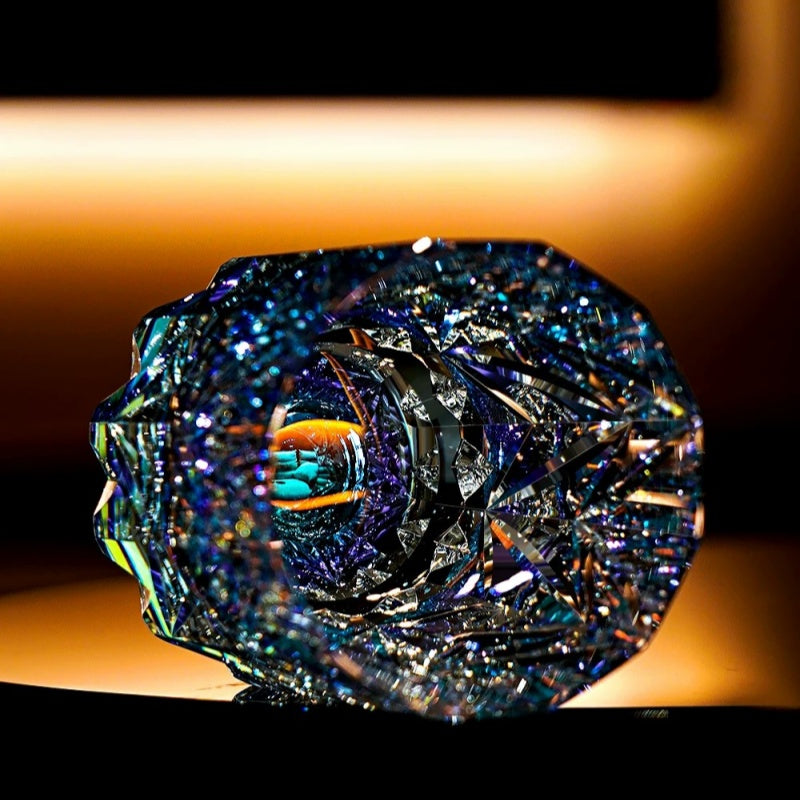
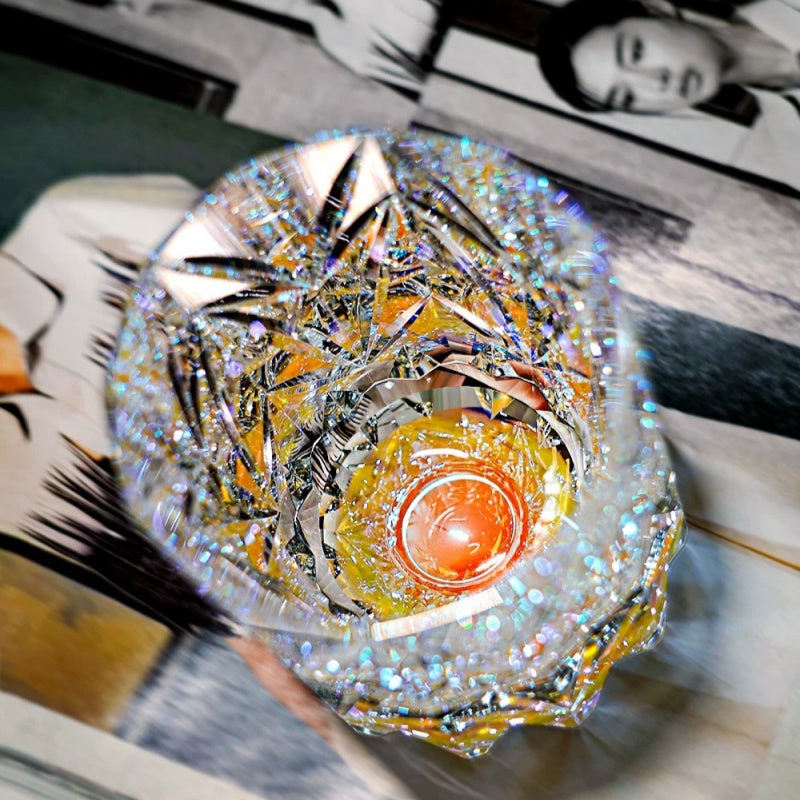
Set the glass against a light and the surface becomes an event. The facets re-refract the beam again and again, and the iridescent layer beneath the base adds fire of its own — blue, violet, cyan, and gold arriving and leaving as the glass turns in the hand. At one angle the engraving reads as a still, architectural pattern; at another, the base throws its spectrum wide across the table. This is where the name comes from: stars, fallen into the glass.
The iridescent finish is applied as a food-grade vacuum coating to the exterior of the base only, so it never comes into contact with what you drink. Under the coating the base reads violet, blue, or green depending on the light. Its arched, concave underside both protects the film from wear and works as a miniature prism, refracting at a wide angle so that cyan, blue, yellow, orange, red, and green arrive together. Because the coating settles differently on each piece, no two glasses shift color in exactly the same way.
The blank itself is cut from a solid crystal cylinder and hollowed by CNC cold-cutting — a slow, costly route chosen for purity. It keeps the body free of inclusions and bubbles, and holds the crispness of every future cut. From there the glass passes through more than ten hand stages: tracing, cutting, grinding, and polishing, each completed by a person holding the piece against a turning wheel.
Balanced at 16.9 ounces (480 g) with a smooth rim and a 7.4 fl oz (220 ml) bowl, the glass gives whisky and aged spirits room to open, and handles a pale beer without thinning its aroma. Selected for its restraint in form and its extravagance in light, it reflects the values GGC looks for in pieces meant to be kept — and it is the kind of object that arrives as a wedding gift and stays as an heirloom.
• Material:
lead-free K9 crystal glass
• Craft:
hand-cut and hand-polished engraving, diamond-wheel cut, CNC cold-cut blank, 10+ hand stages
• Capacity:
7.4 fl oz (220 ml) · Weight: 16.9 oz (480 g)
• Dimensions:
rim dia. approx. 2.95 in (7.5 cm), height approx. 3.54 in (9 cm)
• Note:
measurements are taken by hand and may vary slightly
Specifications
Product Care
MAIN TAINING
HAND WASH
To prevent damage to items, it is recommended to clean them individually using warm water and non-abrasive cleaning products. We recommend setting your dishwasher on gentle mode or washing gently by hand.
DRY AND WIPE
Place the glass on a towel or absorbent kitchen paper and blot it dry, or wipe it carefully while holding the body with your thumbs to reduce pressure. Use lint-free fine cotton or linen towels. Put the cups back into the box or stand them upright without touching each other.
STORAGE and PRESERVATION
The edges of handmade crystal wine bottles are very thin, so they should be placed in a cupboard or packaging box with the cup mouth facing upward to prevent the cup mouths from touching each other. Do not stack wine bottles or hang them with hooks to avoid cracking the handles. Wine bottles should be stored in a clean and tidy place, with the mouth of the cup facing up and the cap open for ventilation.
MAINTENANCE
Do not leave wine in the bottle. Please clean it in time after use. The decanter must be cleaned with a soft sponge in warm water. Do not use detergent. If fog appears, pour some coarse salt and half a liter of alcohol. Shake vigorously and rinse with warm water several times. Insert absorbent kitchen paper into the cup for about 10 hours to absorb residual moisture.
The crystal glass material is purely hand-blown. Occasionally small bubbles and small scratches are normal phenomena. The crystal material is not resistant to high temperatures and cannot be heated and steamed. It is not suitable for boiling water to be poured directly into it. It is only suitable for daily tea temperatures below 50~60℃.
Optionen auswählen

Design
Crafting Of Edo Kiriko
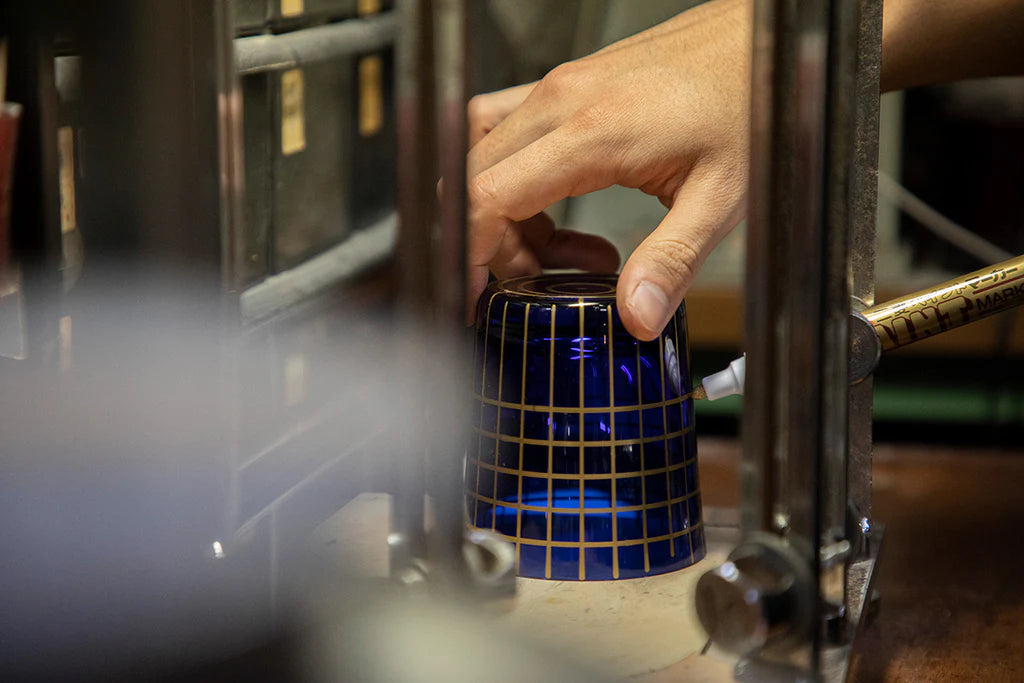
The artist marks simple grid lines on the glass without drawing a design to provide the plan's framework. The design grid is drawn on the glass's surface using a bamboo stick or brush with red iron oxide. Next, the baselines of the design are lightly etched using a whetstone. Relying on these fine marks and lines, the delicate patterns of Edo kiriko are created with the artisan's expertise and skills.
First Cut
The base design is cut to about three-quarters of the final width and depth. The surface of the glass is cut using a sand paste-coated metal disc rotating at high speed. Generally, emery powder with many abrasive particles is used to create the sand paste. The clear pattern border lines and the irregular patterns are cut little by little. The balance between the thickness and depth of the cut lines relies upon the artisan's years of experience, as there are no detailed sketches.

Adjustments
The patterns cut in the second stage are adjusted, and the surface is smoothly polished in this process. A whetstone disc, natural or artificial, is used to cut delicate patterns which cannot be created with the metal disc used in the prior process. This is the last cutting stage to complete the designs, so careful work is required not to leave any powder residue and to ensure a brilliant finish.

Polishing
This is the final stage of production, and it is usually carried out on soda-lime glass (most prevalent type of glass). The opaque surface left by the third stage is returned once more to its original transparent state, with the attractive shine and sparkle typical of Edo kiriko. Chemical processing with hydrofluoric acid is also applied for high-class crystal glass. Depending on the piece, a variety of different polishing discs are used, such as paulownia wood discs, willow wood discs, hair brush discs, and belt discs. The final work is polished by applying water and polishing powders to obtain a glittering finish, while fine sections are polished with a cloth or a brush. To complete the final polishing, a cloth buffing disc is used to bring out the sparkle and shine of the cut glass.